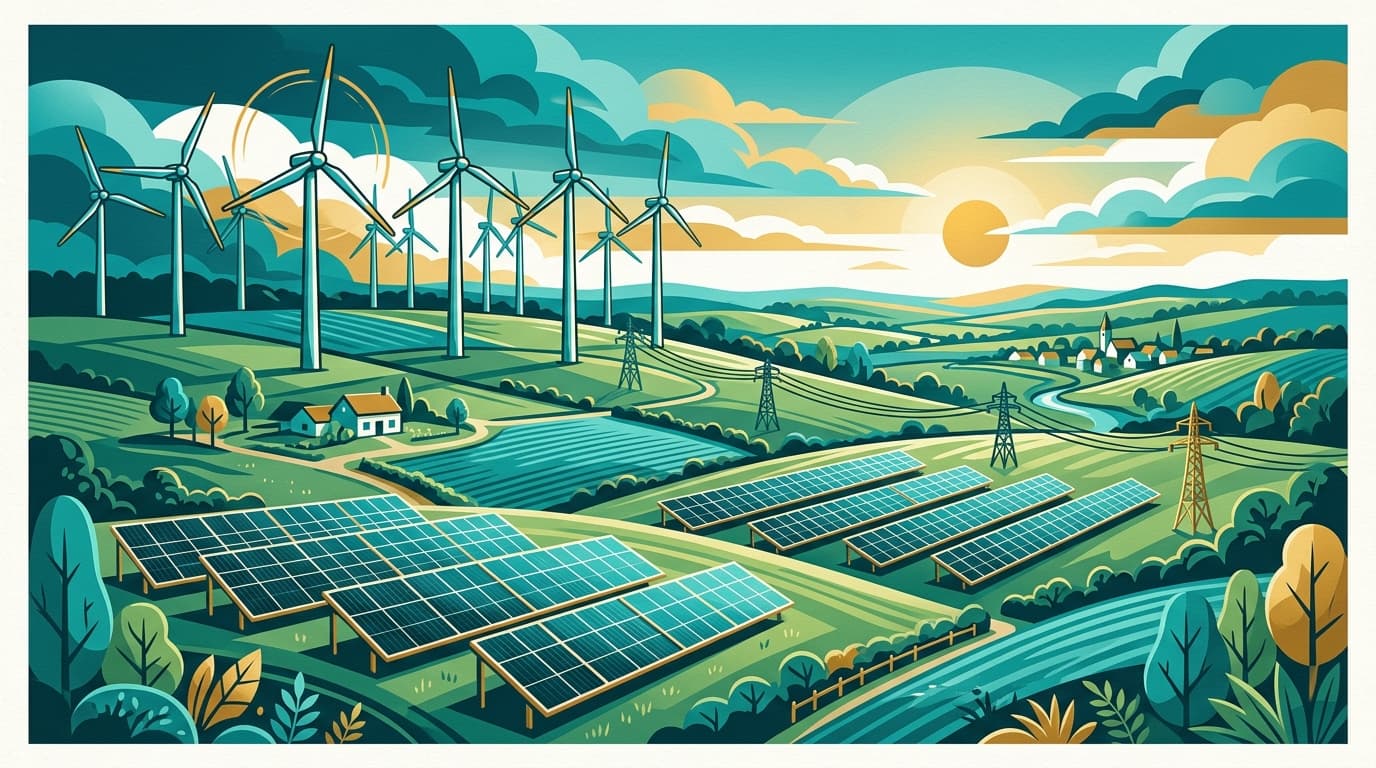
"Green electricity" is probably the most overused claim on the Belgian market: almost every supplier advertises a "green" offer, yet very few actually produce renewable energy. Here is how to tell credible green from greenwashing, which suppliers genuinely stand out, and how to choose without paying more. For the full market overview, see our ranking of the best electricity suppliers.
In short:
- The greenest suppliers are the citizen cooperatives — Ecopower, Cociter and Wase Wind score 20/20 with Greenpeace.
- Large suppliers go green mainly through guarantees of origin, with no Belgian renewable production behind them.
- Credible green isn't necessarily more expensive: cooperatives, Bolt or EnergyVision stay close to market prices.
- The right choice depends on your profile: champion of local energy, pragmatist of honest green, or price hunter.
What is truly green electricity?
Truly green electricity is electricity backed by real renewable production, not just a purchased certificate. In Belgium the nuance is crucial: any supplier can sell a "green" offer by buying guarantees of origin, certificates confirming that a renewable kWh was produced somewhere in Europe. The supplier then "sticks" that label onto electricity of conventional origin, without having produced a single green kWh itself. Conversely, a player that owns its wind turbines and panels supplies energy whose green colour matches a physical production. In practice, two offers both marketed as "100% green" can hide radically different realities: one backed by Belgian wind farms, the other by a mere accounting exercise. This is the distinction I check first when comparing green offers.
Which are the greenest electricity suppliers in Belgium?
It is the citizen cooperatives that dominate, without debate. In the Greenpeace ranking released in late 2025 (the benchmark I follow every year), only three cooperatives — Ecopower, Cociter and Wase Wind — earn the maximum score of 20/20, because they supply only electricity from their own solar and wind installations. Just behind, EnergyVision, a solar specialist, makes a striking entrance at 18/20 and takes 4th place. These players share one thing: their green electricity is not a marketing veneer, but the reflection of renewable production they own or finance. Alongside them, a supplier like Bolt, a platform connecting local producers with consumers, also relies on identifiable Belgian production, which makes it far more credible than the green offers of the big groups.
| Supplier | Type | Green (Greenpeace, late 2025) | Indicative price (3,500 kWh/yr) | Availability |
|---|---|---|---|---|
| Ecopower | Citizen cooperative | 20/20 | cost price + share (~€250) | Flanders |
| Cociter | Citizen cooperatives | 20/20 | cost price + share | Wallonia |
| Wase Wind | Citizen cooperative | 20/20 | cost price + share | Flemish area |
| EnergyVision | Solar producer | 18/20 | from ~€1,400/year | Belgium |
| Bolt | Local green platform | good (local production) | ~€1,500/year | Belgium |
| Mega (green offer) | Supplier + guarantees of origin | low (certificates) | ~€1,479/year (Cosy Flex) | Belgium |

Are the large suppliers really green?
For the most part, no — not in the strict sense. The incumbents and big groups like Engie, Luminus, TotalEnergies and Eneco all offer "green" tariffs, but these rest essentially on guarantees of origin, not on new Belgian renewable production. The Greenpeace report is harsh on this point: according to its analysis, sector suppliers cut their renewable investments by around 51% in five years, while continuing to market green energy heavily "on paper". This does not mean these offers are dishonest under the law — guarantees of origin are a legal, regulated mechanism — but they do not directly finance new wind turbines or panels. So if your main motivation is ecological, it is better to look beyond the "green" label and check where the energy actually comes from.
Is green electricity more expensive?
No, not mechanically — that's the most stubborn myth. A low-cost green offer like Mega Cosy Flex runs around €1,479/year for an average household of 3,500 kWh, among the lowest tariffs on the market, label aside. Cooperatives sell at cost price: with no commercial margin, their kWh often stays in line with, or below, the tariffs of conventional suppliers — the trade-off being the purchase of a share (around €250 at Ecopower), refundable if you leave the cooperative. Bolt and EnergyVision also sit within the market range, generally below the incumbents' tariffs. In other words, the premium for credible green is now marginal, even nil: paying more is no longer the price of genuinely renewable electricity. Always compare your specific case before signing.
Which green electricity supplier should you choose for your profile?
The right choice depends on what you want first. If your priority is maximum ecological impact and support for local production, a citizen cooperative — Ecopower in Flanders, Cociter in Wallonia — is the most coherent option: you directly finance Belgian wind turbines and panels, and buy your electricity at cost price. If you want truly credible green but available everywhere and without a cooperative share, Bolt or EnergyVision offer an excellent compromise between identifiable local production and the flexibility of a conventional supplier. Finally, if price remains your number one criterion while keeping a green offer, a formula like Mega Cosy Flex does the job — provided you accept that its "green" rests on guarantees of origin. A producer like Aspiravi, backed by its own wind farms, is another route for those who want to link supply and real renewable production.
How do you switch to a green electricity supplier?
Switching is free, seamless and handled by the new supplier. You sign up with your chosen green supplier using a recent bill — for your EAN code and annual consumption — and it notifies the previous supplier and organises the changeover. Your installation stays the same: the physical grid remains managed by your distribution operator (Ores, Fluvius, Resa or Sibelga depending on your municipality), and electricity keeps flowing without interruption. Household contracts can be cancelled at any time with one month's notice, free of charge. For a cooperative, one step is added: becoming a member by buying at least one share before receiving your supply. Before deciding, check the environmental ranking on the Greenpeace comparator (monelectriciteverte.be) and compare prices on a CREG-certified comparator, then find the whole market in our ranking of electricity suppliers.
Électricité verte comparator
Compare all électricité verte side by side.
Compare now →
Frequently asked questions
Julien suit le marché belge de l'énergie depuis plus de dix ans. Il a comparé des centaines d'offres d'électricité pour des ménages wallons, bruxellois et flamands, décortiqué les grilles tarifaires de Mega, Bolt, Luminus, Engie ou Eneco, et épluché les rapports de la CREG, du VREG et de la CWaPE. Sa conviction : la plupart des Belges paient leur électricité trop cher faute d'avoir comparé. Sur ce site, il traduit le jargon énergétique en conseils concrets, chiffrés et sans publicité déguisée.