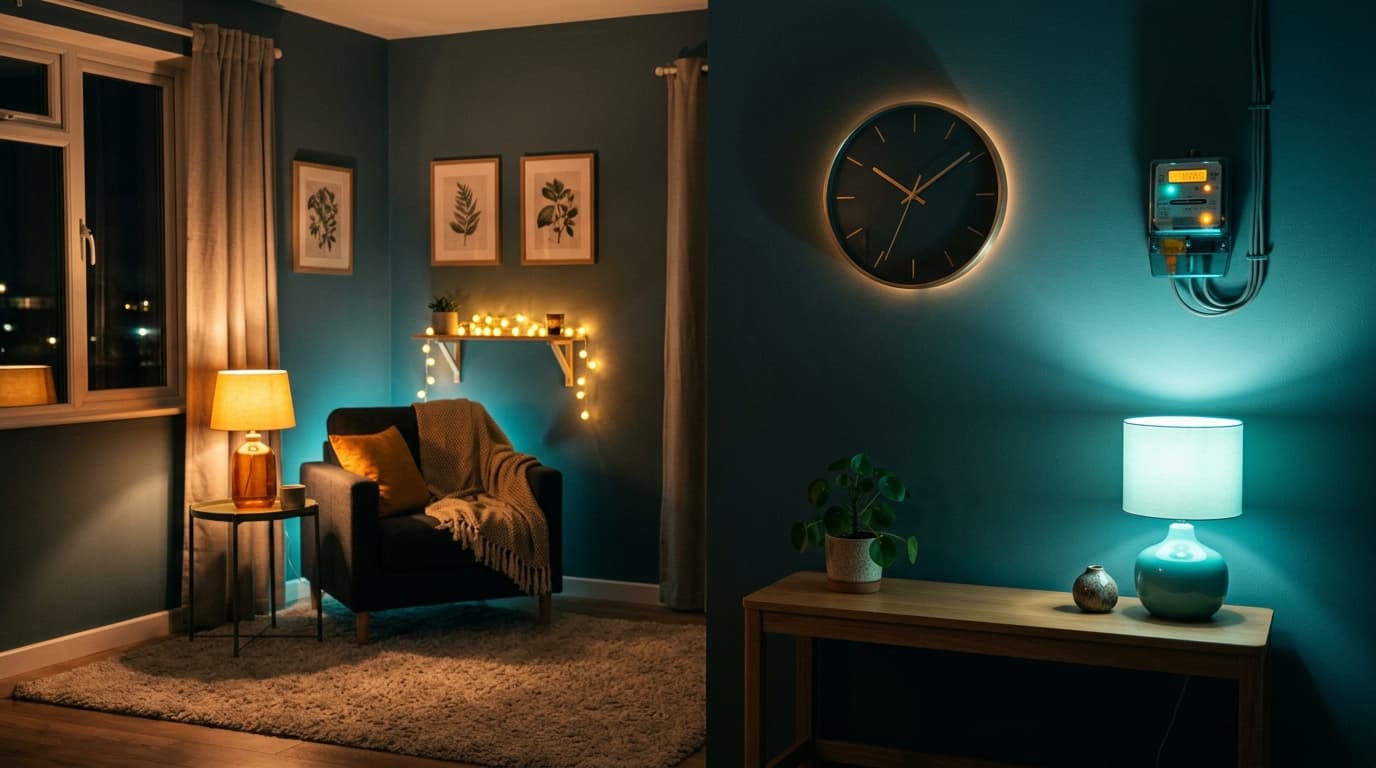
Do you have a dual-rate (bihoraire) meter, or a night-only meter for your heating? Then choosing a supplier isn't about the headline price alone, but about how it bills your off-peak hours. Here's how to decide in Belgium, taking into account the new schedule that came into force this year. For the big picture, see our ranking of the best electricity suppliers.
In short:
- A dual-rate tariff only pays off if you shift at least 40% of your consumption to off-peak hours.
- Since 1 January 2026, off-peak hours in Wallonia run 10pm–7am and 11am–5pm, every day.
- On the energy portion, the day/night gap is only a few cents.
- Mega, Luminus, Engie, TotalEnergies and Bolt all have dual-rate plans: compare on your real profile.
Is a dual-rate tariff still worth it in 2026?
Only if you really consume at night. A dual-rate tariff is worthwhile only when you manage to shift a large share of your consumption to off-peak hours — at least 40%, a threshold confirmed by guides from Mega and Selectra alike. Below that, the sometimes higher fixed network fee of the dual-rate meter eats into the savings made on the night kWh. Concretely, for an average household of 3,500 kWh a year, the right move isn't to rush into a dual-rate plan, but to first measure how much of your usage is genuinely shiftable: washing machine, dishwasher, dryer, water heater, charging an electric car.
What are the new off-peak hours since 2026?
They've changed, and that's the point most households still miss. Since 1 January 2026, Wallonia applies new windows: off-peak hours run from 10pm to 7am and from 11am to 5pm, now identical every day, weekends and public holidays included. Previously the whole weekend switched to off-peak; that's no longer the case. The switch happened automatically on every dual-rate meter, with nothing to do, as the Walloon Region and grid operator ORES point out. The real change in habits, however, isn't automatic: the new 11am–5pm window rewards those who run appliances in the middle of the day — an extra bonus if you have solar panels.
Which supplier should you choose for a dual-rate meter?
The one showing the best combined day + night price on your profile, not just the lowest night rate. On the energy portion, the gap between peak and off-peak hours usually comes down to a few cents per kWh: according to CallMePower, the kWh price ranges in mid-2026 between roughly €0.11 and €0.24 during peak hours, and between €0.10 and €0.18 off-peak depending on the contract. In other words, the choice of supplier matters more than the plain "night" label. In practice, when a household shows me its dual-rate statement, I look first at the annual total, not the off-peak line on its own. Among the players, Mega, the 100% Belgian challenger, is regularly among the cheapest on variable contracts; Bolt applies a cost-price model with a fixed monthly membership, valued for its transparency; Luminus, Engie and TotalEnergies, the incumbents, offer full ranges with consumption-tracking apps useful for steering your usage hour by hour.
Dual-rate or single-rate: how to decide?
By comparing your real share of off-peak consumption. The trap I see most often is the household that keeps a dual-rate plan "on principle" while living mostly in the daytime: it pays a higher network fee without ever benefiting from the night rate. Here's a simple grid to place yourself:
| Your profile | Share in off-peak hours | Recommended tariff |
|---|---|---|
| Home during the day, little shiftable usage | under 25% | Single-rate (simpler, often cheaper) |
| Typical household, programmable appliances | 25 to 40% | Dual-rate, watch closely |
| Night water heater or heating, EV charged at night | over 40% | Dual-rate, clear winner |
I've compared dozens of dual-rate grids: above 40% night-time consumption, dual-rate almost always wins; below 25%, single-rate is the restful choice. In between, it all comes down to the supplier and your discipline.
What if you have a night-only meter?
You can keep it, but its advantage has shrunk. A night-only meter typically feeds storage heating or a hot-water tank. Since 2026, its rate has increased and now aligns with the off-peak rate of a standard dual-rate meter: the old "super night discount" barely exists anymore. For this very night-heavy profile, the lever is therefore no longer the meter type but the supplier: aim for an offer with a competitive kWh price and, if you can, have someone assess the value of shifting some usage onto a now better-positioned standard dual-rate meter.

Dual-rate in Flanders: a special case
In the north of the country, the logic is no longer the same. Flanders replaced the classic dual-rate system with a capacity tariff (capaciteitstarief), calculated on your monthly power peak, via Fluvius and the VREG regulator since 2023. The day/night distinction on the network portion has therefore largely lost its weight there: smoothing your called power often matters more than shifting usage at night. If you're Flemish, the question "which supplier for off-peak hours?" turns into "which supplier and which habits to limit my power peak?".
How do you check you're paying a fair price?
By comparing your current offer to the whole market, on your real consumption. Grab a recent bill for your EAN code and your peak/off-peak split, then use your regulator's official comparison tool — CREG at federal level, CWaPE in Wallonia, VREG in Flanders — and our ranking of the best electricity suppliers to place the offers against each other. Switching supplier is free, without interruption and with one month's notice; your meter stays dual-rate. The right reflex: compare every year, because welcome promotions often fade from the second year onward.
Tarifs & prix comparator
Compare all tarifs & prix side by side.
Compare now →
Frequently asked questions
Julien suit le marché belge de l'énergie depuis plus de dix ans. Il a comparé des centaines d'offres d'électricité pour des ménages wallons, bruxellois et flamands, décortiqué les grilles tarifaires de Mega, Bolt, Luminus, Engie ou Eneco, et épluché les rapports de la CREG, du VREG et de la CWaPE. Sa conviction : la plupart des Belges paient leur électricité trop cher faute d'avoir comparé. Sur ce site, il traduit le jargon énergétique en conseils concrets, chiffrés et sans publicité déguisée.