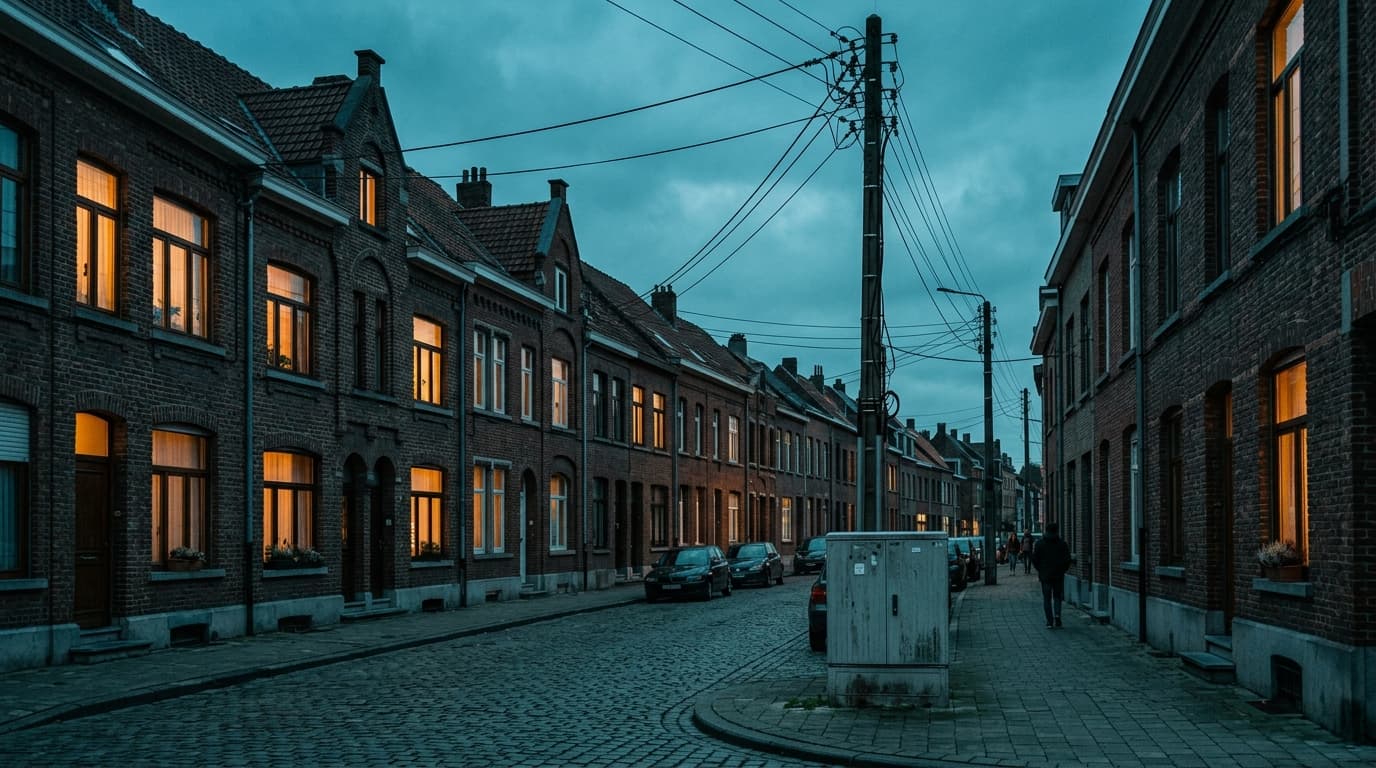
The distribution system operator (DSO), called GRD in French for "gestionnaire de réseau de distribution", owns the cables and the meter that bring electricity to your home. The supplier sells you that electricity and sends the bill. You choose the second, never the first: your address decides between Fluvius, Sibelga, ORES, RESA, AIEG, AIESH and REW.
What is an electricity grid operator?
A monopoly company whose job is to carry power without ever selling it. Belgium has two layers of them. Elia runs the transmission grid, the high voltage lines that cross the country. Distribution system operators take over at medium and low voltage, right up to the meter of each home.
Since the market opened, in 2003 in Flanders then in 2007 in Wallonia and Brussels, both jobs have been separated from the supplier’s. Engie, Luminus, Mega or Bolt compete on the price of energy. The DSO has no competitor: it installs the meter, reads it, assigns the EAN code of the supply point (the 18 digit number identifying your connection), repairs outages and builds new connections.
The confusion comes from the bill. You never receive an invoice from your DSO, yet it weighs heavily on the final amount: according to the breakdown by the CREG, the federal energy regulator, as reported by CallMePower in its update of 1 October 2026, transmission and distribution make up about 33 % of an electricity bill, against 36 % for the energy itself.
Who is my grid operator?
Your municipality decides. In Flanders and Brussels, the answer is a single name. In Wallonia, look at your bill, where the DSO appears next to the EAN code.
| Region | Grid operator | General enquiries | Power outage |
|---|---|---|---|
| Flanders | Fluvius | 078 35 35 34 | 078 35 35 00 |
| Brussels | Sibelga | 02 549 41 00 | 02 274 40 66 |
| Wallonia | ORES | 078 15 78 01 | 078 78 78 00 |
| Wallonia, mostly Liège province | RESA | 04 220 12 11 | 04 263 18 80 |
| Wallonia, local grids | AIEG, AIESH, REW | On their website | On their website |
The numbers for Fluvius, Sibelga and ORES were taken from their websites on 7 October 2026, those for RESA from the CallMePower page updated on 3 March 2026. ORES alone serves about three quarters of Walloon municipalities, according to the same site. REW covers Wavre only, while AIEG and AIESH each supply a handful of municipalities, notably around Andenne for the former and in the southern tip of Hainaut for the latter.
A postcode is not always enough: a few Walloon municipalities are split between two grids. The bill, however, is never wrong.
DSO or supplier: who do you call, and when?
The rule fits on one line: anything about equipment goes to the DSO, anything about money goes to the supplier. On the bills I take apart, most misdirected complaints come from a disputed meter reading sent to the wrong desk.
| Situation | Who to contact | Why |
|---|---|---|
| Power cut in the street | DSO | It operates the grid |
| Meter stuck, damaged or due for replacement | DSO | The meter belongs to it |
| New or upgraded connection | DSO | Work on the grid |
| EAN code nowhere to be found | DSO | It assigns the code |
| Wrong meter reading on record | DSO | It validates and forwards readings |
| Instalment too high | Supplier | It sets the instalment |
| Price per kWh, type of contract | Supplier | It is the supplier’s offer |
| Disputed adjustment bill | Supplier first | It bills, then queries the DSO on the reading |
| Moving house | Supplier | It registers the energy handover document |
| Social tariff request | Supplier | It applies the tariff |
Only one line needs two calls. If your adjustment bill looks too high, the supplier remains your contact, but correcting a wrong reading is decided at the DSO. ORES says so in its FAQ: it carries the legal responsibility for reading meters, and the supplier is the one that draws up the interim or adjustment bill.
How do I find out who my electricity supplier is?
The classic case: you move in, the lights work, and nobody has asked you to sign anything. You will need the meter number or the EAN code, and ten minutes. Cost: 0 €.
- Look for a payment trail. A monthly instalment shows on your bank statements under the supplier’s name. No debit since you arrived? You probably have no contract at all.
- Dig out the energy handover document signed with the previous occupant or the landlord. It lists the meter readings, the EAN code and, often, each party’s supplier.
- Write down the EAN code, 18 digits starting with 54. If it is missing, ORES offers an online form based on the meter number, and Brugel, the Brussels energy regulator, sends Brussels residents to Sibelga on 02 549 41 00.
- Call your DSO with that code. It keeps the access register, the file linking each supply point to the supplier feeding it. It is the only player that knows whether a contract is active at your address, and in whose name.
- Sign a contract in your own name without waiting, even if the power is on. As long as the meter stays tied to the previous occupant, their consumption and yours are mixed up, and the supply point may end up with no contract at all.
If the DSO replies that no supplier is registered, do not conclude that the power is free: the consumption recorded since you arrived will be claimed from you.
Step 5 is not a matter of principle. In its report on 2025, published on 17 July 2026, the CWaPE, the Walloon energy regulator, counts 4,084 disconnections in Wallonia for lack of a contract and 4,929 after a problematic move, against just 13 ordered by a judge for unpaid bills. A home whose meter nobody took over is therefore cut off far more often than an indebted household, as our article on electricity cut off for an unpaid bill explains.

How much does the network cost with each operator?
Up to 82 € a year apart in Wallonia excluding VAT, close to 87 € including VAT, for identical consumption. On 1 July 2025 the CWaPE published the annual distribution cost approved for 2026 at four DSOs. Its typical customer uses 3,408 kWh on a day and night meter. We added the 6 % VAT and the gap with the cheapest.
| Walloon DSO | 2026 distribution, excl. VAT | Incl. VAT | Gap with AIEG | Change since 2025 |
|---|---|---|---|---|
| AIEG | 305 € | 323.30 € | 0 € | +4 % |
| ORES | 325 € | 344.50 € | +21.20 € | +8 % |
| RESA | 329 € | 348.74 € | +25.44 € | +6 % |
| AIESH | 387 € | 410.22 € | +86.92 € | +4 % |
| Weighted average | 327 € | 346.62 € | +23.32 € | +8 % |
REW’s tariffs were approved separately, on 4 September 2025, and are not part of this comparison. Set against a Walloon bill of 1,345 to 1,679 € a year for 3,500 kWh, the range CallMePower recorded in October 2026, distribution alone accounts for between a fifth and a quarter of the total. The two profiles are not strictly identical, so keep the order of magnitude.
In Flanders, the grid is one but its price is not. Fluvius applies eight tariff zones: the capacity tariff costs 51.99 to 60.53 € per kW of peak per year including VAT, a 36 € annual gap between Limburg and West Flanders for the average peak of 4.24 kW. In Brussels, Sibelga applies one grid to all 19 municipalities, with a flat fee of 47.24 € a year up to 13 kVA according to Infor GazElec.
No supplier can do anything about these amounts.
That is why two neighbours in adjoining municipalities, both on the same Mega or Luminus offer, do not pay the same bill, and why a comparison tool asks for your postcode before anything else: it uses it to identify the DSO, hence the share of the bill on which no competition applies, before ranking suppliers on the rest.
Three cases where the grid operator supplies you itself
The separation of roles has exceptions, all tied to household protection.
- In Wallonia, the DSO becomes the social supplier of regional protected customers, to whom it applies the social tariff. It can also feed a supply point temporarily as "supplier X", until a situation is sorted out.
- In Flanders, a household whose contract was terminated for non payment and which cannot find another one moves to Fluvius as social supplier. The Flemish regulator counted 80,028 electricity customers there in its report of 18 June 2026.
- In Brussels, Sibelga supplies protected customers at the social tariff while their commercial contract is suspended.
In all three regions, this supply remains a safety net and not an offer: nobody can sign up for it out of convenience.
Should the DSO weigh on your choice of supplier?
No, with one exception. Network charges are the same with every supplier for a given address, and Brugel points out that switching is free and that supply is never interrupted during the transition. The DSO simply reads the meter on the switch date.
The exception is the structure of the network tariff, which steers the type of contract. Wider off peak hours in Wallonia since 1 January 2026, a peak billed per kW in Flanders: these rules come from the DSO and the regulator, and they decide whether a day and night or dynamic contract earns you anything. For the part you control, our ranking of the best electricity suppliers compares offers by profile, and the bill simulator puts a figure on your case by region and consumption.
Tarifs & prix comparator
Compare all tarifs & prix side by side.
Compare now →
Frequently asked questions
Julien suit le marché belge de l'énergie depuis plus de dix ans. Il a comparé des centaines d'offres d'électricité pour des ménages wallons, bruxellois et flamands, décortiqué les grilles tarifaires de Mega, Bolt, Luminus, Engie ou Eneco, et épluché les rapports de la CREG, du VREG et de la CWaPE. Sa conviction : la plupart des Belges paient leur électricité trop cher faute d'avoir comparé. Sur ce site, il traduit le jargon énergétique en conseils concrets, chiffrés et sans publicité déguisée.