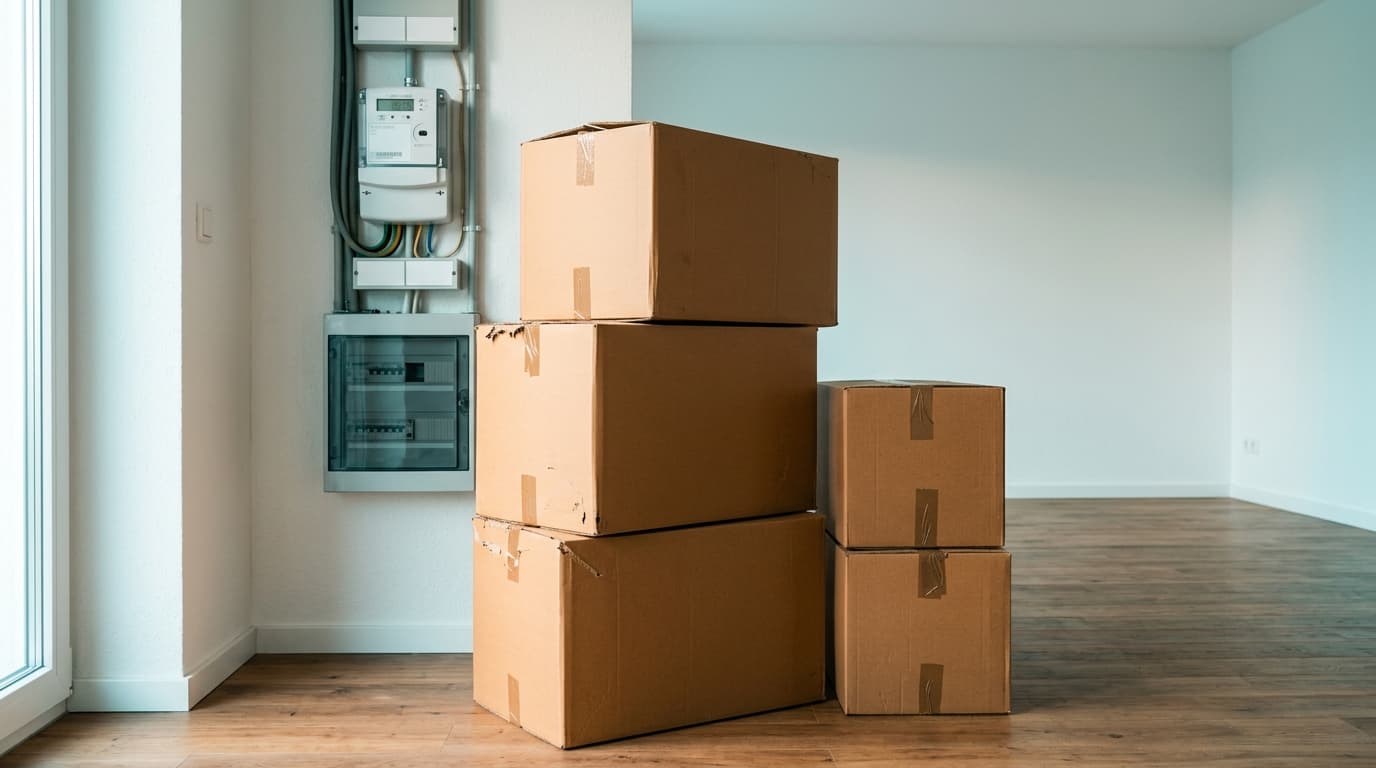
Moving house is when you stack up boxes, hunt for the new entrance code… and almost always forget to compare your electricity. Yet it's the golden opportunity to pay less: switching supplier costs nothing and causes no power cut. Here's how to choose the right supplier for your new address, and how not to miss any of the steps. For the full market table, see our ranking of the best electricity suppliers.
Is moving house the right moment to switch supplier?
Yes, it's actually the best moment. In Belgium, all residential electricity contracts can be cancelled at any time, with no fees and no notice to pay, since the consumer agreement in the open market: a move therefore triggers no penalty if you take the chance to switch. In practice, instead of letting your old contract follow you by default, you can sign up elsewhere for the new address and put suppliers in competition. In the cases I see, this is where the biggest savings hide: a household that hasn't compared in three years often pays €150 to €250 too much a year, on electricity alone.
Which electricity supplier should you choose when moving?
The best supplier depends on your priority: price, guidance or green energy. There's no single winner, but a sorting by profile. On price alone, Mega, the 100% Belgian challenger, is regularly the cheapest for an average household. If you want an established point of contact and a guided moving service, Engie and Luminus, the two incumbents, are more reassuring. And if your new home makes you want to switch to credible green power, Bolt or Eneco are worth a look. Here's how they compare in July 2026 for a single-rate meter.
| Supplier | Strength when moving | Offer type | Indicative cost 3,500 kWh/yr* | Best for |
|---|---|---|---|---|
| Mega | 100% online sign-up, often the cheapest | Variable (Cosy Flex) | ~€1,027/yr | Paying the least, no branch |
| Engie | Branch network, multi-energy management | Fixed & variable | ~€1,288/yr | The reassurance of a big group |
| Luminus | Full customer portal, guided moving journey | Fixed & variable | ~€1,294/yr | Being guided step by step |
| Bolt | Belgian green, clear app, no advertising | Variable / dynamic | market-based | Moving into a "green" home |
| Eneco | Online handover document, flexible offers | Fixed & variable | market-based | Handling your move on your own |
*July 2026 estimates for a 3,500 kWh/yr household, single-rate meter, excluding welcome promotions. Sources: supplier grids and the CallMePower comparator.

Does my contract follow me automatically to the new address?
Yes, by default your contract follows you — but it isn't compulsory. If you simply notify your current supplier of your move, it transfers the same conditions to your new home. That's convenient, but it's also the trap: without realising it, you renew a rate that may no longer be competitive. The right reflex is to treat the move as a reset. Compare first, then decide: keep your supplier by renegotiating the offer, or sign up elsewhere. The physical grid doesn't change hands: it stays managed by your distribution operator (ORES, Fluvius, RESA or Sibelga depending on the municipality), whichever supplier you pick.
Which documents to prepare: EAN code, reading, handover document?
Three items are enough: the EAN code, the meter reading and the energy handover document. The EAN code is a unique 18-digit number always starting with 54, specific to each meter; you'll find it on a recent bill for the home, on the meter, or from the grid operator. The meter reading is the figure shown by the meter on the day of the change. Finally, the energy handover document (DRE) is a form the outgoing and incoming occupant fill in and sign together on the handover date. Careful: the DRE isn't a contract and doesn't take over the previous occupant's contract — it only fixes the readings. As the CWaPE and suppliers such as Eneco or Mega point out, this document has real legal value and serves as proof in case of a dispute over readings.
How far in advance should I notify my supplier?
Plan at least 14 days, ideally a month. The consumer agreement in the open market recommends notifying your supplier at least 14 days before the move, but several suppliers ask for one month's notice to arrange the switch calmly. The trick, when you change supplier: have the new contract start on the day you get the keys to your new home, and cancel the old one from the day you leave the old one. This slight overlap prevents a home ending up without a contract — a situation where the grid operator applies a default rate, clearly more expensive.

Fixed, variable or dynamic contract for a new address?
For a new address, the variable contract is the most flexible starting point. In 2026, variable offers remain 15 to 20% cheaper than fixed offers at most suppliers, Mega, Luminus and Engie included. Fixed locks in your price per kWh for one or two years: reassuring if you fear an increase, but more expensive up front. Yet when you move in, you don't yet know your real consumption in the new home — floor area, insulation, heating. Starting on variable, then switching to fixed once consumption stabilises, avoids locking yourself in too early. Very attentive profiles with a smart meter can look at the dynamic tariff, but that's an optimisation choice, not a default starting point for a move.
How to avoid the adjustment bill and the pitfalls of moving?
Take your meter readings and never leave a home without a contract in your name. The surprise adjustment bill almost always comes from two mistakes: badly noted readings, or an underestimated monthly instalment. On the day of departure and of arrival, photograph the meter and note the reading on the signed handover document; that's your proof. Then re-estimate your yearly consumption honestly when signing up: an instalment that's too low inflates the final adjustment. Finally, never count on "the power staying on": without a contract in your name, the grid operator charges a default rate, more expensive, and the bill can sting. Before signing, always check your specific case via the official comparator of the CREG, VREG or CWaPE, and browse the whole market in our ranking of electricity suppliers.
In short, a move isn't just a chore of boxes: it's the best opportunity of the year to pay a fair price for your electricity. Prepare your EAN code, sign the handover document, have the new contract start on the day of the keys — and above all, compare before letting your old contract follow you out of habit.
Types de contrats comparator
Compare all types de contrats side by side.
Compare now →
Frequently asked questions
Julien suit le marché belge de l'énergie depuis plus de dix ans. Il a comparé des centaines d'offres d'électricité pour des ménages wallons, bruxellois et flamands, décortiqué les grilles tarifaires de Mega, Bolt, Luminus, Engie ou Eneco, et épluché les rapports de la CREG, du VREG et de la CWaPE. Sa conviction : la plupart des Belges paient leur électricité trop cher faute d'avoir comparé. Sur ce site, il traduit le jargon énergétique en conseils concrets, chiffrés et sans publicité déguisée.