The energy takeover document (document de reprise des énergies in French) is a form shared by Belgium's three regions, signed by the occupant who leaves and the one who arrives, which freezes the meter readings on the day the keys change hands. It is not a contract. It is filled in twice, free of charge, and protects both parties in a dispute.
It does not choose your supplier for you, though: for that, our ranking of the best electricity suppliers remains the starting point.
What is the energy takeover document?
A joint meter reading, nothing more. The three regional regulators, the VREG for Flanders, the CWaPE (the Walloon energy regulator) for Wallonia and Brugel for Brussels, launched it together on 17 June 2013 to replace each supplier's in-house forms. It is used whenever the occupant of a supply point changes: moving house, sale, rental, separation or death.
Its value lies in the two signatures. Each party keeps a copy, which has "legal value in case of dispute", according to the regulators' press release. But it transfers nothing: Brugel's Disputes Service ruled in 2018 that the document "is not equivalent to an energy contract".
Searches by brand show it clearly: people type "document de reprise des énergies Engie", "Luminus" or "TotalEnergies", as if each supplier had one. It is the same everywhere. The CWaPE points out that every Belgian supplier must accept the common form, even when it publishes its own version.
What do you need to write on the form?
I read the regulators' form, the OCTA+ version and the instructions from Sibelga and Fluvius side by side. The fields are identical, give or take a few details:
- the date of the takeover and the address of the home;
- the electricity EAN code, 18 digits starting with 54, and the gas one if there is one;
- the meter number and type, then the readings: one for a single-rate meter, two (day and night) for a dual-rate meter, one more for an exclusive night meter;
- in Brussels, for a home with solar panels, the offtake and injection readings, so two or four figures according to Sibelga;
- whether there is a prepayment (budget) meter;
- the identity of both parties, their suppliers, and the status of the incoming party: tenant, owner-occupier or owner of an empty home;
- two signatures preceded by "lu et approuvé" (read and approved).
A move involves two addresses. You therefore need one form when you leave and one when you arrive, each in two copies: four signed sheets in total, Sibelga points out.
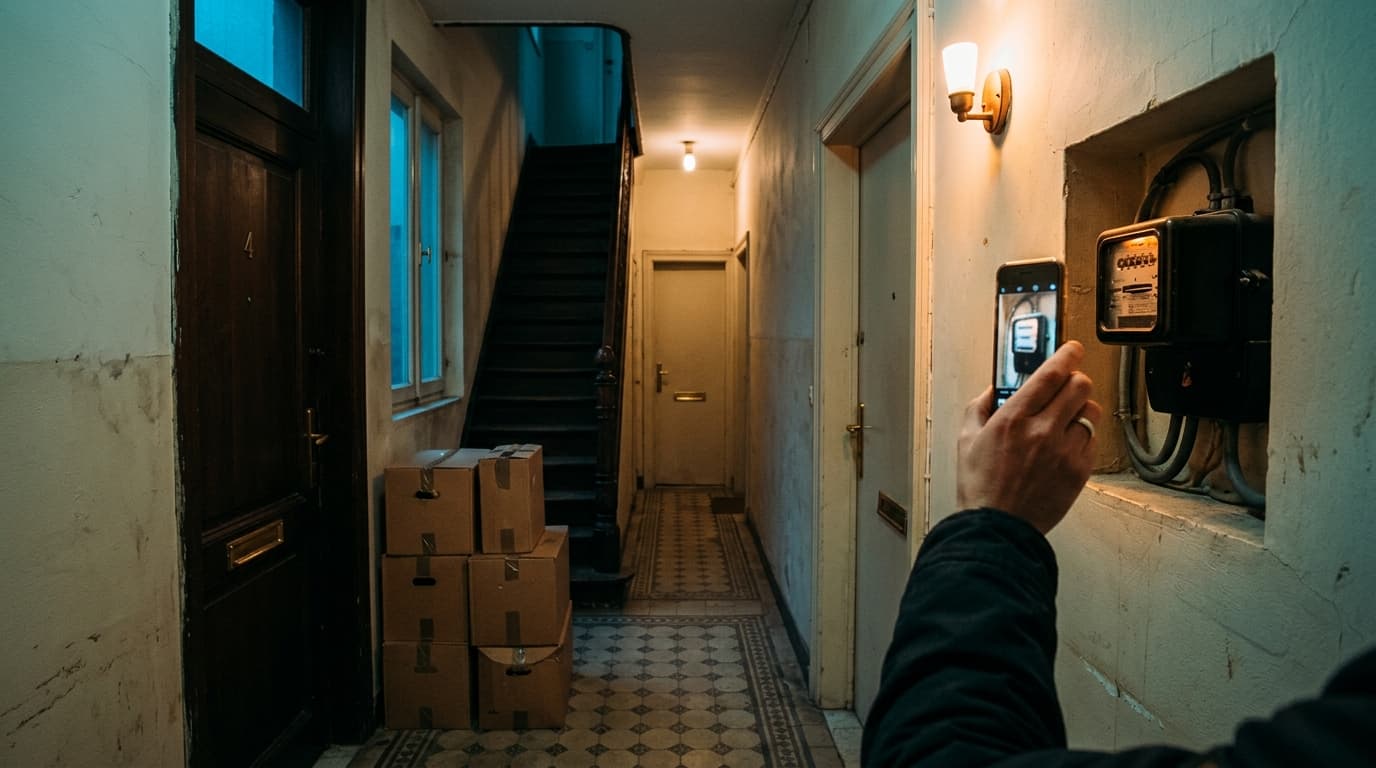
Photograph the meter.
Who do you send it to, and by when?
To your supplier, not to the grid operator. Each party passes its data to its own supplier: the outgoing occupant to the one that will send the closing bill, the incoming one to the one opening their contract. At Engie, this goes through the MyEngie customer area or 078 35 33 33; at OCTA+, by email at energie@octaplus.be, no later than 7 days after the move. The supplier then informs the grid operator: in Brussels, Brugel recommends it do so within three calendar days of receiving the form.
The legal deadline, however, depends on the region, and Wallonia is the surprise: the Walloon decree on public service obligations sets no number of days for the customer, but requires each supplier to publish its own on its website, to confirm in writing within seven days any reading received by phone, and to send the closing bill within six weeks of the end of the contract.
| Wallonia | Brussels | Flanders | |
|---|---|---|---|
| Regulator | CWaPE | Brugel | Vlaamse Nutsregulator (formerly VREG) |
| Grid operator (DSO) | ORES, RESA, AIEG, AIESH, REW | Sibelga | Fluvius |
| Deadline to notify the supplier | Set and published by each supplier | 7 days after the move | 7 days after the key handover |
| No contract for the new occupant | Letter from the DSO within 5 working days, 10 days to sign, then suspension | MOZA procedure: on-site closure if no contract 45 days after the first letter | Limited temporary supply (90-day rule cited by Brugel) |
| Reopening a closed meter | ORES residential amount not readable in the published grid | 164 € with a technician, 16 € remotely (2026) | 104.28 € incl. VAT with a technician, free remotely (2025 grid) |
Sources: be.brussels and the Sibelga FAQ for Brussels, Fluvius brochure of February 2026, Sibelga non-periodic tariffs 2025 to 2029 published by Brugel, Fluvius low-voltage connection grid as of 1 January 2025, Brugel opinion of 18 September 2024. Reopening amounts were taken by us from the grid operators' price lists.

Do you still need it with a digital meter?
Yes.
This is where online guides contradict each other. One comparison site states, on its page about Engie, that the form becomes unnecessary with a digital meter. The CWaPE writes the opposite in black and white: the form must be completed even with a digital meter, and remote readings only take priority if they are actually taken. The meter knows what was consumed; it does not know who lived in the home or at what time the keys changed hands.
What digital does change is the cost of a mistake, since Sibelga reopens a smart meter remotely for 16 € instead of 164 €, and Fluvius does not charge for these remote interventions.
What if nobody takes over the home?
Between two tenants, the landlord becomes responsible for consumption and must take out a contract themselves, then fill in the form with the departing tenant. Some suppliers offer a contract for unoccupied homes. If the other party refuses to sign, Fluvius advises a dated photo of the readings, sent alone with a note of the refusal. Without any of these steps, the grid operator eventually closes the meter, and the figures show this is no theoretical threat. In Wallonia, the CWaPE report on 2025, published on 17 July 2026, counts 4,929 disconnections after a problematic move and 4,084 for lack of a contract, against 13 court-ordered disconnections for unpaid bills. In Brussels, 46 % of the 2,351 disconnections in 2025 followed the end of a contract according to Brugel, or about 1,080 disconnections by our calculation. A badly closed move cuts off far more households than debt does, and our article on disconnection for an unpaid bill covers the other side.
What does a forgotten takeover document cost?
Without joint readings, the supplier estimates. Brugel describes the trap precisely in its September 2024 opinion: the new occupant's contract starts on the previous occupant's exit date, with their exit readings, and the newcomer pays for consumption from before they arrived.
We put a figure on that shift for a household using 3,500 kWh a year, at the average all-in price published by the CREG (the federal energy regulator) for the fourth quarter of 2026.
| Period wrongly billed | kWh | Wallonia (37.79 c€) | Brussels (36.88 c€) | Flanders (32.25 c€) |
|---|---|---|---|---|
| 2 weeks | 134 | 50.73 € | 49.51 € | 43.29 € |
| 1 month | 288 | 108.71 € | 106.09 € | 92.77 € |
| 3 months | 873 | 329.76 € | 321.82 € | 281.41 € |
Calculation: 3,500 kWh spread evenly over 365 days. The CREG price includes fixed charges: it is an order of magnitude, not your bill.
On top of that, if the meter has been closed, comes the reopening: 257 € at Sibelga for an urgent intervention on the next working day, up to 513 € for a same-day reopening.

Seven situations, seven reflexes
| Situation | What to do |
|---|---|
| You leave a rental and a tenant moves in | Form signed with them, one copy each, each to their own supplier |
| You leave and the home stays empty | Form signed with the landlord, who takes out a contract in their name |
| You buy a home | Form signed with the seller on the day of the key handover, contract in your name from that date |
| The contract holder has died | Form dated on the death or the takeover, then a contract in the occupant's name |
| Separation, one partner stays | Form dated on the departure, contract taken over in the name of the one who stays |
| The other party refuses to sign | Dated photo of the readings, sent alone to the supplier with a note of the refusal |
| Prepayment meter | In Wallonia, contact the supplier; in Flanders, the grid operators of both addresses |
The form settles the readings, not the price. A move remains the moment when switching supplier costs nothing, and our guide to the best supplier when moving house compares Mega, Engie, Luminus and the others on that point. If you do not know your EAN code or your grid operator, start there; to end the old contract, follow our cancellation guide, then estimate the new bill with the simulator.
Types de contrats comparator
Compare all types de contrats side by side.
Compare now →
Frequently asked questions
Julien suit le marché belge de l'énergie depuis plus de dix ans. Il a comparé des centaines d'offres d'électricité pour des ménages wallons, bruxellois et flamands, décortiqué les grilles tarifaires de Mega, Bolt, Luminus, Engie ou Eneco, et épluché les rapports de la CREG, du VREG et de la CWaPE. Sa conviction : la plupart des Belges paient leur électricité trop cher faute d'avoir comparé. Sur ce site, il traduit le jargon énergétique en conseils concrets, chiffrés et sans publicité déguisée.