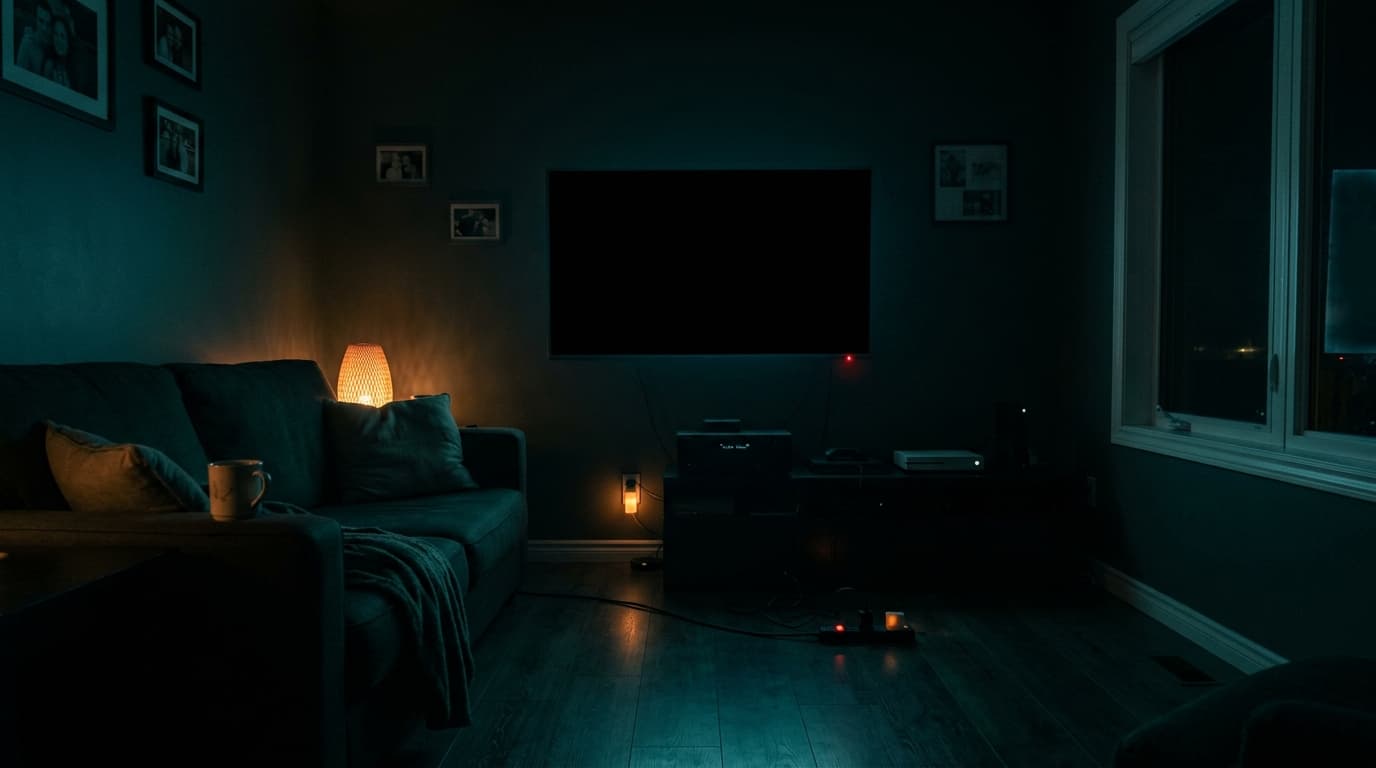
An average Belgian household loses 140 to 220 kWh a year to standby, or €48 to €75 according to Energuide, the information service run by Sibelga, the Brussels grid operator. That is real, but half of what most top-ranking pages claim, because they are written for France. And the money no longer hides where people look for it.
How much power do appliances on standby use in a Belgian household?
Between 5 and 8 % of a home's electricity.
That is the range used by Energuide, Sibelga's energy information portal: 140 to 220 kWh a year for an average Belgian household, an invisible cost of €48 to €75 based on an all-in price of €0.34/kWh recorded in March 2026. In a heavily equipped home, écoconso, a Belgian sustainable-consumption organisation, goes up to 350 kWh a year.
The figures you will find elsewhere are much larger. The French pages that dominate search results quote ADEME, the French environment agency, and announce 10 to 15 % of the bill, 300 to 500 kWh, sometimes more than €100 a year. They are not wrong for their audience: they reason on a French reference household of 5,700 kWh a year, often heated electrically, with French regulated tariff prices that do not exist here. Applied as they stand to a Belgian household of 3,500 kWh, they inflate the problem.
One methodological detail also exposes how fragile some widely copied tables are: one of them, published by a French comparison site and updated on 25 September, attributes 77 kWh a year to a television drawing 4 W on standby, whereas 4 W around the clock comes to 35 kWh.
0.5 watts: classic standby has become almost free
The argument of this article fits into one figure, and it comes from Brussels, in the European sense of the word.
Since 9 May 2025, EU Regulation 2023/826 has capped the consumption of new household and office equipment sold in the Union: 0.5 W in off mode and simple standby, 0.8 W if the appliance displays information such as the time. Off mode will drop to 0.3 W on 9 May 2027. Energuide sums up the combined effect of successive standards: in fifteen years, classic standby has been divided by ten.
Let us do the maths. An appliance drawing 0.5 W all year uses 4.4 kWh, or €1.45 at the cheapest Belgian kWh and €2 at the average Brussels price. Switching off ten recent appliances of this kind saves the price of a coffee a month, if that.
There is one exception, and it changes everything: networked standby. An appliance that must stay reachable over the network, such as an internet box, a decoder, a smart speaker or a console updating overnight, is allowed 2 to 8 W depending on its type, and up to 8 W for so-called high network availability equipment. Sixteen times more than simple standby. And that cap only applies to equipment placed on the market since May 2025: the decoder that has sat under your TV for five years is not covered.
Which appliances use the most power on standby?
Those connected to a network, almost always.
The table below takes the standby power levels measured by the Swiss Federal Office of Energy and published by écoconso, and converts them into euros at Belgian September 2026 prices. We calculated each row on permanent standby, 24 hours a day, then applied two prices: €0.33/kWh, the all-in price of the cheapest kWh recorded in Wallonia by CallMePower on 24 September 2026, and €0.46/kWh, the average Brussels price recorded by Selectra on 16 September 2026.
| Appliance | Standby | Per year | At €0.33/kWh | At €0.46/kWh |
|---|---|---|---|---|
| TV decoder | 10 W | 87.6 kWh | €28.91 | €40.02 |
| Hi-fi system | 8 W | 70.1 kWh | €23.13 | €32.01 |
| Modem-router | 7.5 W | 65.7 kWh | €21.68 | €30.01 |
| Laser printer | 5 W | 43.8 kWh | €14.45 | €20.01 |
| Desktop PC and monitor | 3.5 W | 30.7 kWh | €10.12 | €14.01 |
| Games console | 2.5 W | 21.9 kWh | €7.23 | €10.00 |
| New compliant appliance | 0.5 W | 4.4 kWh | €1.45 | €2.00 |
| LED television | 0.3 W | 2.6 kWh | €0.87 | €1.20 |
The first four rows alone weigh more than all the others combined. A decoder costs more than thirty times as much on standby as the television it feeds. Test-Achats, the Belgian consumer association, had measured in its January 2018 magazine, as cited by écoconso, that decoders from Orange, VOO, Telenet and Scarlet used three times more power on standby than in use. In its tests published on 13 May 2024, the association puts the maximum saving from systematically unplugging every tested device at €112 a year, and notes that a NAS alone costs €30 to €35 a year.
One reading precaution is needed. These power levels come from measurements taken between 2015 and 2018, on a stock of appliances that has since been partly renewed; yours may be lower, rarely higher. Only measuring settles it.

Wallonia, Brussels, Flanders: a standby kWh does not cost the same
Standby is one of the few loads that never stops. It is therefore billed differently depending on the region, because network tariffs, time bands and, in Flanders, the very structure of the bill differ.
| Region | Regulator, DSO | Average kWh incl. VAT | 180 kWh of standby | Off-peak hours | Specific feature |
|---|---|---|---|---|---|
| Wallonia | CWaPE, ORES and RESA | €0.4496 | €80.93 | 62.5 % of hours | Off-peak window from 11 a.m. to 5 p.m. since January 2026 |
| Brussels | Brugel, Sibelga | €0.4568 | €82.22 | 55.4 % of hours | Most expensive standby per average kWh |
| Flanders | VREG, Fluvius | €0.4021 | €72.38 | 55.4 % of hours | Capacity tariff billed per kW |
CWaPE, Brugel and VREG are the Walloon, Brussels and Flemish energy regulators; a DSO (distribution system operator) runs the local grid. The average prices come from Selectra's reading of 16 September 2026: they divide the full annual bill by 3,500 kWh, fixed charges included, and therefore slightly overstate the cost of one extra kWh. The 180 kWh sits in the middle of Energuide's range. The off-peak share is calculated over the 168 hours of a week, using the time bands in force for a dual-rate meter.
Three readings follow, and none of them appears in the guides we consulted.
A Walloon dual-rate meter now bills 105 hours out of 168 at the reduced rate, thanks to the 11 a.m. to 5 p.m. window introduced by CWaPE on 1 January 2026; a continuous load such as standby mechanically benefits more than in Brussels or Flanders, where the week has 93 off-peak hours.
In Flanders the average price looks lower, but the VREG capacity tariff adds a charge based on your peak power. Every 30 W left on permanently raises that peak by 0.03 kW, or €1.56 to €1.80 a year at a tariff of €52 to €60 per kW, provided your monthly peak exceeds the 2.5 kW floor, which is the case for most households.
That is negligible, and that is precisely the useful conclusion: in Flanders, standby costs almost nothing in capacity, it costs in kWh. In Brussels, finally, each standby kWh is the most expensive in the country, by a small margin.
Should you unplug everything at night?
No, and this is where the classic objection deserves to be taken seriously.
Unplugging costs time, wear on sockets and sometimes useful functions. Test-Achats points this out for inkjet printers, which need to clean their heads, and for OLED televisions, which are best left powered for half an hour after use while they run their screen maintenance cycle. The internet box often carries the landline, overnight updates, sometimes the alarm or the smart thermostat.
- Switch off without hesitation: the decoder when you are not watching TV, the games console, the hi-fi system, the laser printer, the desktop PC and its monitor, chargers left without a device.
- Switch off with judgement: the OLED television, after a half-hour delay; the inkjet printer, only if you rarely print.
- Leave powered: the modem-router, the thermostat and smart plugs, the NAS if you use it, the fridge and freezer, which are not on standby but running.
- Never touch: the fuse board. Cutting a whole circuit to kill standby is work on the installation, to be done by a certified electrician, and the installation remains subject to the regulatory inspection.
So the right question is not "should I unplug" but "which appliances deserve a switch". Answer: those in the first four rows of the table.
Switched power strip, smart plug or standby killer?
The simplest one almost always does the job. Switched off sixteen hours a day, a typical TV corner (10 W decoder, 2.5 W console, 8 W hi-fi) saves 119.7 kWh a year, or €39.51 to €54.69. A smart plug such as the Shelly Plug S Gen3 automates the cut-off, for €1.39 a year of its own standby according to Test-Achats. The system from Belgian company Smappee, fitted in the fuse board by an installer, is rather meant for whole-home diagnosis. Before buying anything, a €15 to €20 plug-in meter (our measuring guide) tells you whether your decoder draws 1 W or 15 W.
Standby weighs less than your price per kWh
This is the heart of the analysis, and it runs against most energy-saving advice: for a Belgian household, hunting down standby saves a few dozen euros a year, while the gap between two electricity contracts runs into hundreds, so the order in which you tackle things matters as much as what you tackle.
In September 2026, according to CallMePower, the annual bill for 3,500 kWh ranged from €1,295 to €1,598 depending on the offer, a €303 gap. The energy component alone ranged from €0.1060/kWh at EnergyVision to €0.2439/kWh for Luminus's Comfy+ offer; on fixed prices, Selectra recorded Mega's Prepaid Fixed offer at €0.1830/kWh on 16 September. Against those figures, Energuide's €48 to €75 of standby represents one sixth to one quarter of what a well-chosen contract switch brings in.
The two do not compete. They come in order.
Start by checking your price per kWh in our ranking of the best electricity suppliers, turn your consumption into euros with the bill simulator, then go after standby: each kWh avoided will then be worth exactly what you pay for it, no more, no less.

Above 100 watts at night, standby is no longer the problem
There is a test anyone can do tonight. Read your meter index before going to bed, with everything off except the fridge and freezer, then read it again when you wake up; divide the difference in kWh by the number of hours elapsed. If you have a digital meter, the customer portal of Fluvius, ORES or Sibelga even shows the quarter-hour curve of the previous night.
A result of around 30 to 60 W is normal: that is the fridge, the box and a few standby loads. Above 100 W, baseline consumption reaches 876 kWh a year. At Belgian prices, that is €289 to €400. Little red lights are no longer the cause. Look instead for an old freezer, a heating circulation pump running in summer, a badly programmed electric water heater or a portable heater forgotten in a room. To tell power from energy in these measurements, our article on the difference between kW and kWh gives you the keys.
And if your last bill came as a shock without this test revealing anything, the culprit is probably elsewhere: our guide to an electricity adjustment bill that is too high covers the other leads, starting with a badly set monthly instalment. The prices quoted here are dated September 2026; the CREG, the federal energy regulator, regularly publishes its analyses of price trends, worth checking before you redo the maths.
Réduire sa facture comparator
Compare all réduire sa facture side by side.
Compare now →
Frequently asked questions
Julien suit le marché belge de l'énergie depuis plus de dix ans. Il a comparé des centaines d'offres d'électricité pour des ménages wallons, bruxellois et flamands, décortiqué les grilles tarifaires de Mega, Bolt, Luminus, Engie ou Eneco, et épluché les rapports de la CREG, du VREG et de la CWaPE. Sa conviction : la plupart des Belges paient leur électricité trop cher faute d'avoir comparé. Sur ce site, il traduit le jargon énergétique en conseils concrets, chiffrés et sans publicité déguisée.