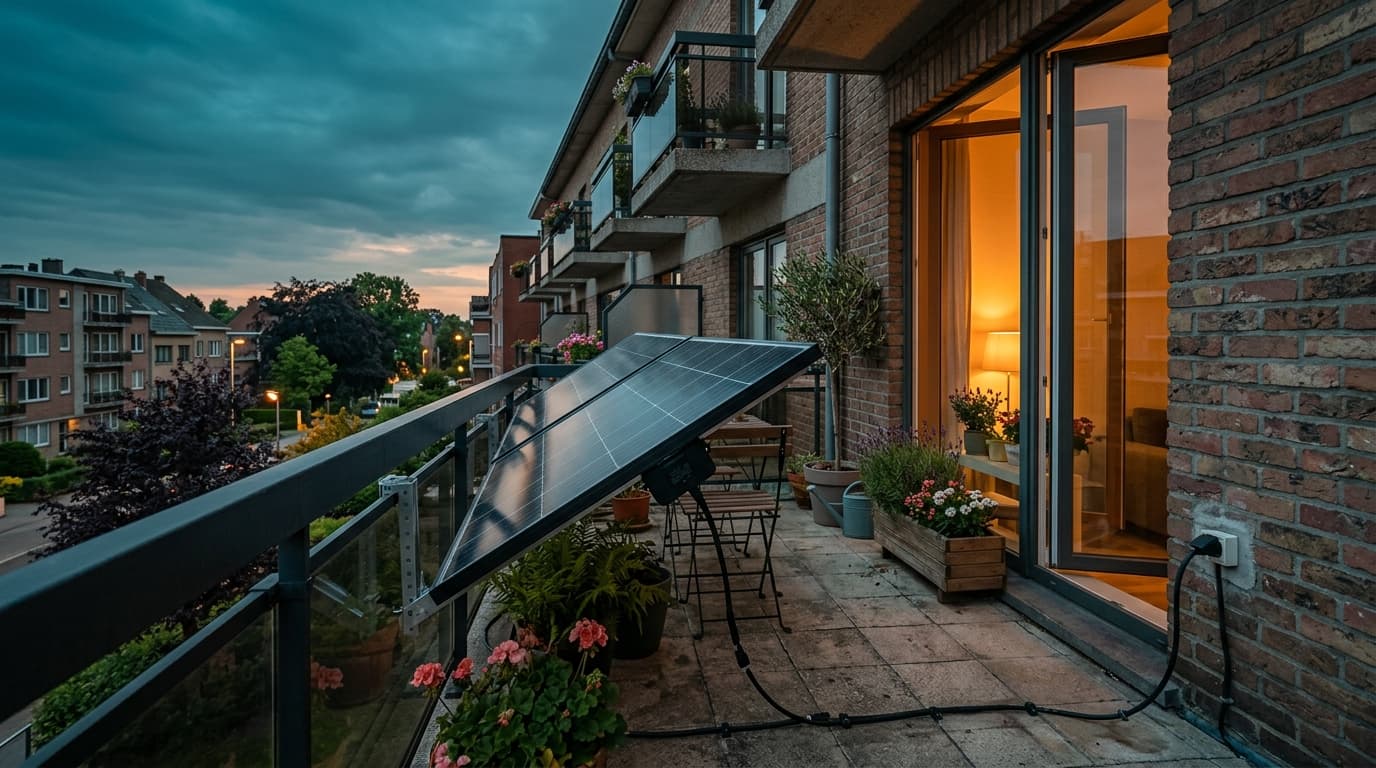
Yes, plugging a solar panel into a wall socket has been legal in Belgium since 17 April 2025. An approved kit of 400 to 880 Wp costs between €400 and €650 and pays for itself in two to seven years, depending on your region and on the share you consume yourself. Without a communicating meter in Wallonia or Brussels, do not buy yet.
Is a plug-and-play solar panel legal in Belgium?
Yes, on one technical condition. The kit's inverter, the box that turns the panel's direct current into the alternating current your home uses, must appear on the approval list of Synergrid, the federation of Belgian grid operators.
Before April 2025, Belgium was among the last countries in Europe to ban these kits. Eighteen months on, the market has outrun the rule: Pluginfo.be, a platform that compiles the grid operators' figures, counted about 8,000 registered devices on 16 April 2026, more than three quarters of them in Flanders, some 550 panels in Wallonia and around sixty systems in Brussels. It puts the real fleet at five to twenty times that number.
Do you have to register your kit, and with whom?
The answer changes from one region to the next, and this is where guides contradict each other. A DIY chain's guide consulted on 5 October 2026 still claimed that only analogue meters trigger registration, in Brussels as in Flanders. That is wrong for Brussels.
| Region | Grid operator (DSO) | Registration | Meter required |
|---|---|---|---|
| Wallonia | ORES, RESA, AIEG, AIESH, REW | Mandatory | Communicating meter |
| Brussels | Sibelga | Mandatory | Smart meter |
| Flanders, digital meter | Fluvius | From 800 W of inverter power, within 30 days | Already in place |
| Flanders, analogue meter | Fluvius | Always, within 30 days | Replaced after registration |
A DSO, or distribution system operator (gestionnaire de réseau de distribution, GRD, in French), owns the local grid and your meter; you cannot choose it. In Wallonia, ORES sets two cumulative requirements: a communicating meter and a notification to the grid operator. For an installation commissioned after 1 January 2024, network costs are calculated on the energy actually drawn from the grid, with no tariff applied to what you inject. The flat-rate prosumer tariff therefore does not apply to a new kit. The trap is for long-standing prosumers: anyone who adds more than 1 kWe to an existing installation loses net metering.
In Flanders, Fluvius waives registration for a kit under 800 W plugged in behind a digital meter, unless you want to be paid for your surplus. The Vlaamse Nutsregulator (VNR, the Flemish energy regulator, formerly VREG) specifies that the threshold applies to combined inverter power. In Brussels, Sibelga's Energuide requires both registration and a smart meter, and points out that these kits do not qualify for green certificates.

How much does a kit produce, and how fast does it pay back?
Not much, but every kWh produced and used on the spot avoids a kWh bought at full price.
Test-Achats, the Belgian consumer organisation, uses a maximum of 380 kWh a year for a well-oriented 400 W panel, about 11 % of a household's needs. We applied that same ratio of 0.95 kWh per Wp to three kits whose prices we checked, then valued the output at the CREG tariff for the fourth quarter of 2026, the average all-in price paid by households as published by the CREG, the federal energy regulator: 37.79 c€/kWh in Wallonia, 36.88 in Brussels and 32.25 in Flanders. Two self-consumption assumptions frame the result: 100 %, as Test-Achats does, and 60 % for a home that is empty during the day.
| Kit | Price checked | Maximum output | Saving at 60 % (Wallonia, Brussels, Flanders) | Payback at 60 % | Payback at 100 % |
|---|---|---|---|---|---|
| One 400 W panel, Test-Achats reference price | €539 (February 2026) | 380 kWh/year | €86, €84, €74 | 6.3 to 7.3 years | 3.8 to 4.4 years |
| Solarleicht, one 440 Wp panel | €419 (5 October 2026) | 418 kWh/year | €95, €93, €81 | 4.4 to 5.2 years | 2.7 to 3.1 years |
| Solarleicht, two 440 Wp panels, 800 W inverter | €639 (5 October 2026) | 836 kWh/year | €190, €185, €162 | 3.4 to 4.0 years | 2.0 to 2.4 years |
These durations are floors, for three reasons. The CREG tariff is an average that includes standing charges, whereas a kWh avoided only removes the variable part of the bill. In Flanders, the capacity tariff is calculated on the evening peak, which the sun does not reduce. And an east-facing balcony, or one shaded in the afternoon, will never reach the ratio used here.
The two-panel kit comes out as the best value per euro invested, with one reservation: 836 kWh a year is close to a quarter of a 3,500 kWh household, and nobody consumes all of it directly without shifting usage towards midday.
800 W, 1,000 W, 3,000 W: the power not to exceed
Searches for 3,000 W kits are common in Belgium. They rest on a misunderstanding.
The figure that matters is the inverter's output power, not the panels' rating. The 880 Wp Solarleicht kit sold by Gamma delivers 800 W at most, and the EcoFlow STREAM Ultra battery system listed at MediaMarkt advertises 3,000 W of panels for an 800 W micro-inverter. That 800 W step matches the Flemish registration threshold. ORES, for its part, sets 10 kVA as the ceiling of the simplified regime, all generation combined.
No socket was designed to receive current. Fluvius refers to the general regulation on electrical installations and to the manufacturer's instructions, and Sibelga points out that the capacity of the circuit must not be exceeded. On this point the only valid answer comes from a certified electrician, who looks at your consumer unit before you buy.
Which criteria should you check before buying?
Price comes last. Four checks come before it.
- The inverter named on the product sheet, brand and model, with the reference C10/26. The sheet for the two-panel Solarleicht kit showed it on gamma.be when we checked on 5 October 2026, although the product was unavailable online that day.
- The home's meter, communicating or not, which decides whether you can plug in legally in Wallonia and Brussels.
- The mounting frame and its ballast. Gamma states a 100 kg load per two-panel kit and a footprint of 360 by 120 cm: not every balcony can take it.
- Your baseload, meaning the power your home draws permanently. Our guide to tracking your consumption in real time explains how to measure it.
The first criterion is no formality. In its survey published on 28 August 2026, Test-Achats examined 19 kits sold by ten retailers: approval of the inverter could be confirmed for only 10 of them, and more than half of the online product sheets gave neither brand nor model. The 300 W Beem Energy kit was listed at €305 on brico.be on 5 October 2026, and the page did not mention approval: in that case, check the Synergrid list yourself before paying.

Balcony, flat, co-ownership: who has to agree?
Nobody for the connection, several people for the mounting. Sibelga names two safeguards: a planning permit depending on the municipality, and the consent of the co-owners' association as soon as the building's appearance is affected. A tenant will add the landlord's. The kit remains your property and moves with you.
Five mistakes that wipe out the gain
- Buying before checking your meter, then finding out you have to wait for a replacement.
- Adding a second kit without rereading the thresholds: 800 W combined in Flanders, 1 kWe added for a Walloon prosumer.
- Going through a power strip or an indoor extension lead. Test-Achats asks for an extension lead rated for outdoor use when the socket is not.
- Counting on selling the surplus, when that requires a feed-in contract and pays little.
- Buying a battery to fix an oversized kit. Test-Achats reports prices of €1,000 to €2,000, and Flanders requires a plug-in battery to be registered in every case.
When is it better not to buy?
Three situations, going by the figures above.
You own a roof and have the budget for a fixed installation: plug-and-play costs more per Wp installed, around €1,150 per kWp according to Test-Achats. You still benefit from Walloon net metering and are thinking of two kits. Or your only possible spot faces north.
In the other cases, the sums hold. A kit does not change the price of the kWh you keep buying in the evening and in winter, more than three quarters of your consumption: our ranking of the best electricity suppliers compares Belgian offers by profile, the bill simulator puts a number on your case, and the guide to the best supplier for solar panels covers selling your surplus. The quarterly tariffs used here are those published by the CREG.
Réduire sa facture comparator
Compare all réduire sa facture side by side.
Compare now →
Frequently asked questions
Julien suit le marché belge de l'énergie depuis plus de dix ans. Il a comparé des centaines d'offres d'électricité pour des ménages wallons, bruxellois et flamands, décortiqué les grilles tarifaires de Mega, Bolt, Luminus, Engie ou Eneco, et épluché les rapports de la CREG, du VREG et de la CWaPE. Sa conviction : la plupart des Belges paient leur électricité trop cher faute d'avoir comparé. Sur ce site, il traduit le jargon énergétique en conseils concrets, chiffrés et sans publicité déguisée.