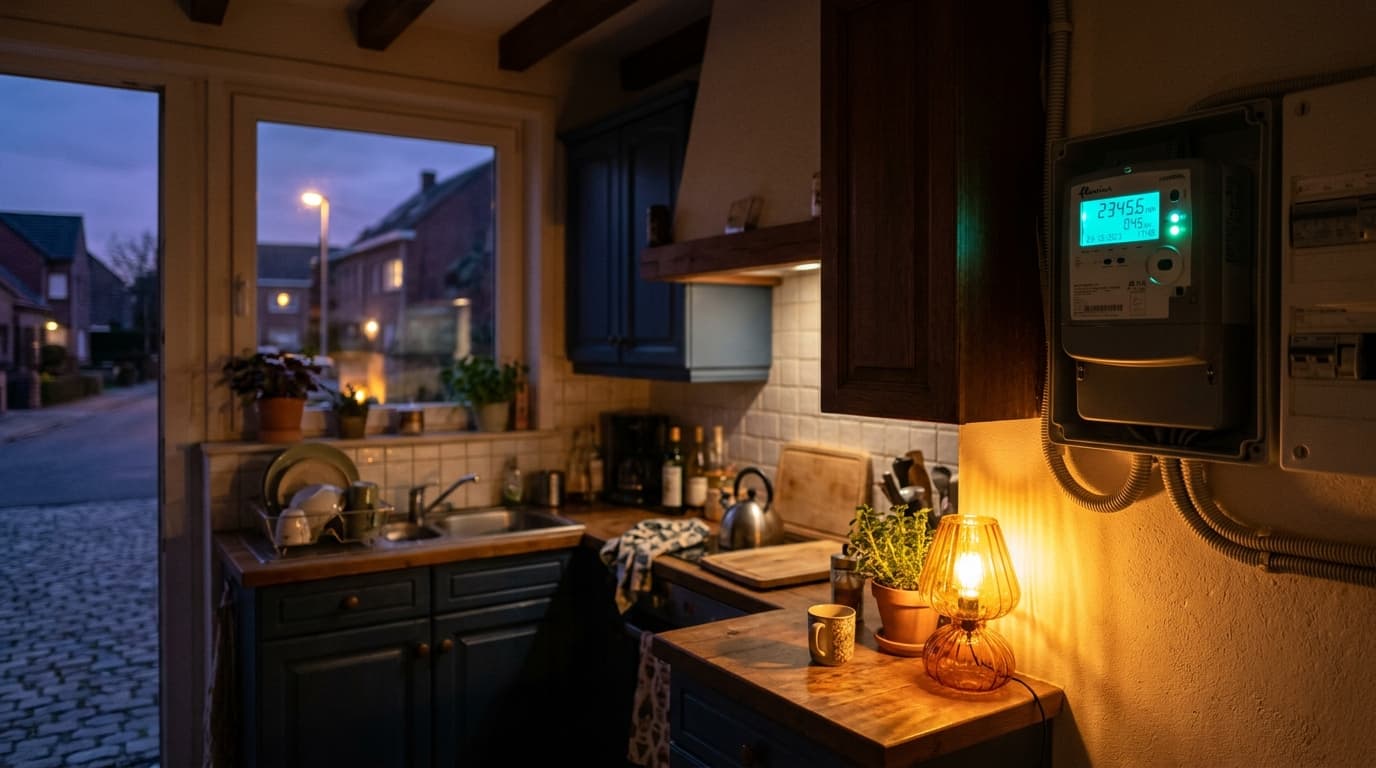
An average Belgian household uses 2,100 to 2,700 kWh of electricity a year according to measurements by the regional regulators, not the 3,500 kWh repeated everywhere. That last figure is a price comparison profile. Here is where both come from, and how to place your own consumption.
3,500 kWh, the average nobody actually uses
Type the question into a search engine. The first pages will tell you 3,500 kWh a year, or 3,480, sometimes 3,900.
The figure is not wrong. It just isn't an average. The 3,500 kWh is the Dc profile, a standard consumer defined at European level so that regulators can compare supplier prices on an identical basis, from one country to another and one quarter to the next. The CWaPE, the Walloon energy regulator, uses it in its residential price observatory dated 26 June 2025, which puts the weighted average annual bill for this profile in Wallonia at €1,305.39. Comparison sites and supplier simulators, ours included, start from the same yardstick. It has one decisive quality, stability, and an equally clear flaw: it describes a dual-rate household using 1,600 kWh by day and 1,900 kWh by night that very few homes will recognise as their own.
Eurostat itself stopped thinking this way. Since the second half of 2007, its price statistics no longer refer to "standard reference consumers" but to consumption bands, with band DC running from 2,500 to under 5,000 kWh. Belgian regulators kept the old profiles for their comparisons, and the web mistook them for averages.
How much does a household really use in Brussels, Flanders and Wallonia?
Less, and very unevenly by region. Two regulators publish a measured figure or one they treat as average; the third publishes none.
| Region | Regulator, DSO | Published average | Per month | Per day | Source and date |
|---|---|---|---|---|---|
| Brussels | Brugel, Sibelga | 2,104 kWh | 175 kWh | 5.8 kWh | Brugel, press release of 4 December 2024 |
| Flanders | Vlaamse Nutsregulator, Fluvius | 2,662 kWh | 222 kWh | 7.3 kWh | 2024 measurement, page updated 24 June 2026 |
| Wallonia | CWaPE; ORES, RESA, AIEG, AIESH, REW | No recent average | n/a | n/a | Dc profile of 3,500 kWh, tariffs calculated on 3,408 kWh |
| Comparison profile | CREG and regulators | 3,500 kWh | 292 kWh | 9.6 kWh | European Dc profile |
The monthly and daily values are our divisions of the annual figures. DSO stands for distribution system operator (GRD in French), the company that runs your local grid and that you cannot choose.
In Brussels, Brugel measures the effect of its distribution tariffs on an average household of 2,104 kWh. The low figure is no mystery: many flats, smaller homes, and heating and hot water that mostly run on gas. In Flanders, the Vlaamse Nutsregulator, the Flemish regulator that succeeded the VREG, measured 2,662 kWh for an average household in 2024 and points out that the figure is pulled down by solar panels.
Wallonia does not publish a recent measured average. A Walloon State of the Environment factsheet goes back to 2014 data, and the 2,000 kWh figure attributed to the CWaPE in several articles has been circulating since at least 2019, with no source document we could trace. The CWaPE works with the Dc profile and calculated its 2026 to 2029 distribution tariffs on a dual-rate standard customer of 3,408 kWh. A Walloon looking for "their" average therefore officially has only a yardstick.

Where does the "1,200, 2,350, 3,200, 7,500 kWh" table come from?
Largely from a mix-up. This table by number of occupants appears, with variations, on the three pages that dominate Belgian search results: 1,200 kWh for one person, 2,350 for two, 3,200 or 3,480 for three or four, then a jump to 7,500 kWh. Nobody sources it. Yet four of its rows reuse the comparison profiles published by the CWaPE and the Vlaamse Nutsregulator, relabelled as household sizes.
| Profile | Annual total | Day | Night | Exclusive night | Official description | Online reuse |
|---|---|---|---|---|---|---|
| Da | 600 kWh | 600 | n/a | n/a | Small consumer, one meter | Absent |
| Db | 1,200 kWh | 1,200 | n/a | n/a | Relatively small consumer | "1 person" |
| Dc | 3,500 kWh | 1,600 | 1,900 | n/a | Standard household, dual-rate meter | "3 to 4 people" |
| Dd | 7,500 kWh | 3,600 | 3,900 | n/a | Relatively large consumer | "4 to 5 people" |
| De | 20,000 kWh | 3,600 | 3,900 | 12,500 | Storage heating or electric water heater | Absent |
The day and night splits are those of the CWaPE and the Vlaamse Nutsregulator; the last column summarises the competing pages consulted on 21 October 2026. The "2 people, 2,350 kWh" row matches no profile, and we could not find its origin. One page even copies the Dc profile's day and night split (1,600 and 1,900 kWh) word for word under the heading "3 to 4 people", while showing a total of 3,200 kWh that does not match the sum.
The Vlaamse Nutsregulator goes to the trouble of stating in black and white that these categories "do not reflect representative customers in Flanders". The jump from 3,500 to 7,500 kWh between three and five people is therefore no size effect. The Dd profile describes a large consumer, and nothing says how many people live under its roof.
Suppliers do not always help. Engie put forward 3,900 kWh for an average Belgian household of 2.4 people in a 2019 article, without a source. Mega gives, in a blog post updated in February 2026, regional ranges of 2,500 to 3,000 kWh for Brussels and 3,500 to 4,000 kWh for Wallonia, also without a primary source: the first exceeds Brugel's figure by 400 to 900 kWh.
How much for 1, 2 or 4 people?
The only Belgian grid by household size we found comes from Homegrade, the housing advice centre of the Brussels Region. Its "High energy bills" factsheet, updated in February 2023, distinguishes three consumption levels excluding hot water, then adds 850 kWh per person per year when water is heated by an electric tank, based on 15 m³ of hot water per person.
We applied this rule to the grid's "normal" consumption and converted the result into euros.
| Household | Frugal | Normal | High | Normal with electric water heater | Indicative cost, normal with heater |
|---|---|---|---|---|---|
| 1 person | 1,500 kWh | 2,200 kWh | 4,000 kWh | 3,050 kWh | €1,226 to €1,393/year |
| 2 people | 1,500 kWh | 2,200 kWh | 4,000 kWh | 3,900 kWh | €1,568 to €1,782/year |
| 3 people | 1,900 kWh | 2,600 kWh | 4,400 kWh | 5,150 kWh | €2,071 to €2,353/year |
| 4 people | 2,300 kWh | 3,000 kWh | 4,800 kWh | 6,400 kWh | €2,573 to €2,924/year |
| 5 people | 2,700 kWh | 3,400 kWh | 5,200 kWh | 7,650 kWh | €3,076 to €3,495/year |
The first three consumption columns are Homegrade's. The fourth and the cost are our calculations, at the average all-in price recorded by Selectra on 16 September 2026: €0.4021/kWh in Flanders and €0.4568/kWh in Brussels. These average prices spread fixed charges over 3,500 kWh; they therefore slightly underestimate the cost of small volumes and overestimate that of large ones.
Two readings stand out. Household size weighs little: from two to five people, normal consumption gains only 1,200 kWh, 400 kWh per extra occupant. Hot water weighs a lot: an electric water heater adds 1,700 kWh for a couple, more than going from two to five people without one. And the 7,500 kWh Dd profile, which online tables attribute to "4 to 5 people", mostly looks like a household of five heating its water with electricity.
Water heater, heating, car: three uses that change the scale
The big gaps between households almost never come from everyday appliances. They come from three uses, which on their own take a home out of any average:
- Electric hot water. 850 kWh per person per year according to Homegrade, or about €340 to €390 per occupant at the September 2026 average price. A dual-rate or exclusive-night meter cuts the cost, not the quantity.
- Electric heating. This is the De profile, at 20,000 kWh including 12,500 on an exclusive-night meter for storage heaters. Our article on the supplier for electric heating covers this case, and the one on the heat pump its alternative.
- An electric car charged at home. It adds several thousand kWh depending on mileage, and in Flanders it also raises the power peak used to calculate the capacity tariff.
- Solar panels, in the opposite direction. They do not reduce the home's consumption but the amount drawn from the grid, which is what the meter measures and the averages record.
Everything else plays out in hundreds of kWh, not thousands. Standby, for example, weighs 140 to 220 kWh a year according to Energuide, which our article on standby appliances converts into euros.

Below average, the bill does not fall as much
Here is the nuance that pages on average consumption leave out, and it matters to every household that finds itself more frugal than the 3,500 kWh benchmark: part of the bill does not depend on kWh, so halving your consumption never halves your bill, and a small consumer actually pays more per kWh than the displayed average.
Examples are easy to find. In Flanders, the Fluvius capacity tariff charges a minimum peak of 2.5 kW, or €130 to €151 a year depending on the zone, even if you use almost nothing. In Brussels, Sibelga charges a flat €47.24 in 2026 for a connection up to 13 kVA, according to Infor GazElec, the independent energy information service. On the supplier side, the fixed fee ranges from €53 a year at Cociter to €95 at EnergyVision, according to their 2026 rate cards.
For a Brussels household on 2,104 kWh, the energy component therefore weighs less in the bill than for the 3,500 kWh profile, and the gap between suppliers narrows. It does not disappear. In September 2026, the energy component ranged from €0.1060/kWh at EnergyVision to €0.2439/kWh for Luminus's Comfy+ offer according to CallMePower, and Selectra recorded Mega's Prepaid Fixed offer at €0.1830/kWh on 16 September. Over 2,104 kWh, the gap between the two extremes is still worth about €290 a year.
That is why our tools ask for your real consumption. The ranking of the best electricity suppliers compares offers on the benchmark profile; the simulator redoes the calculation on your own kWh, which can change the order of the ranking for a small consumer. Our article on the supplier for low consumption shows how.
How can you place your consumption in five minutes?
Open your last annual adjustment bill: the consumption for the past twelve months appears in kWh, often split between day and night. With a digital meter, your Fluvius, ORES or Sibelga customer portal also shows it, day by day. Then compare that total with your household's row in the Homegrade grid, adding 850 kWh per person if your hot water is electric.
Above the "high" column, look first for a water heater, a portable heater or an old freezer.
Our guide to tracking consumption in real time helps find which one, and the article on the difference between kW and kWh helps read the figures without mixing up units.
Réduire sa facture comparator
Compare all réduire sa facture side by side.
Compare now →
Frequently asked questions
Julien suit le marché belge de l'énergie depuis plus de dix ans. Il a comparé des centaines d'offres d'électricité pour des ménages wallons, bruxellois et flamands, décortiqué les grilles tarifaires de Mega, Bolt, Luminus, Engie ou Eneco, et épluché les rapports de la CREG, du VREG et de la CWaPE. Sa conviction : la plupart des Belges paient leur électricité trop cher faute d'avoir comparé. Sur ce site, il traduit le jargon énergétique en conseils concrets, chiffrés et sans publicité déguisée.