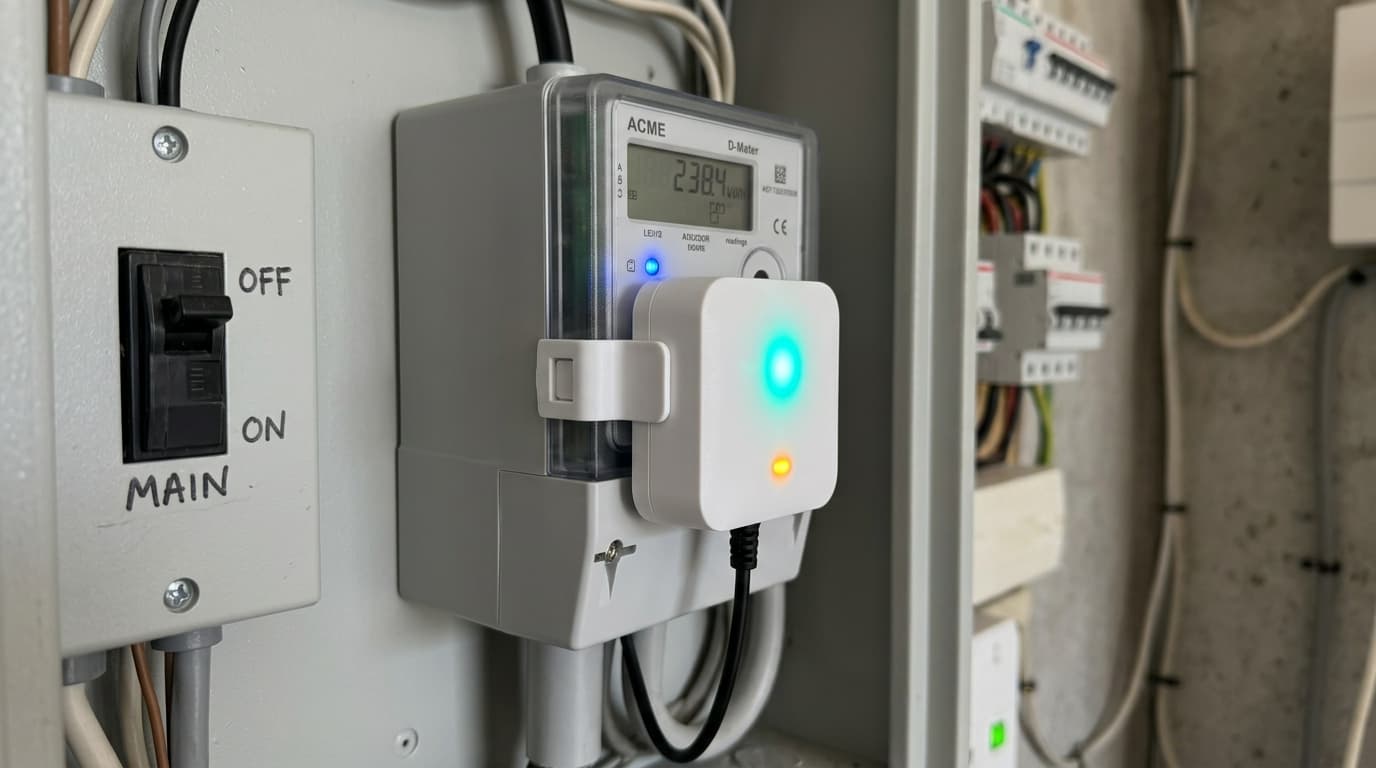
Yes, it is possible in Belgium, and without changing your meter. Every digital meter installed by your grid operator has a P1 port, and a small box clipped onto it will show your consumption second by second. The remaining question is whether that port is switched on — and that depends on your region.
Can you really watch your electricity use live in Belgium?
Yes, and for a few dozen euros.
Contrary to what almost every page ranking on this question says — they are written for France, around the Linky meter and Enedis — Belgium has neither Linky nor Enedis, and the procedure here has nothing in common with what those sites describe.
Everything runs through the P1 port of your digital meter. It is a physical RJ12 socket, present on meters installed by Fluvius, ORES, RESA or Sibelga — the four distribution system operators, or DSOs, known in French as gestionnaires de réseau de distribution (GRD). The port streams raw data once a second: active power in kW, meter index in kWh, solar export if you have panels, and gas consumption every five minutes. You clip a box onto it, and the curve appears live on your phone.
One caveat, straight away: the port is closed by default in Flanders and Wallonia, for privacy reasons. The hardware is useless until it has been opened.
What exactly do you need, depending on your situation?
| Your situation | What you need | What you will see |
|---|---|---|
| Digital meter, P1 port already open | A P1 dongle (~€29) | Electricity by the second, solar export, gas every 5 min |
| Digital meter, P1 port closed | An activation request to your grid operator, then the dongle | The same, once activation takes effect |
| Old spinning-disc meter | Nothing compatible — clamp measurement fitted by a certified electrician | The power your home draws, not the official meter index |
| You want to target ONE appliance | A plug-in power meter or a smart plug with metering (~€19) | Live power and cumulative kWh for that appliance only |
| You just want to understand your bill | Nothing to buy | 15-minute intervals from the previous day, in your customer portal |
Two rows deserve a read before you reach for your card. On a spinning-disc meter, no P1 dongle exists: there is no port, full stop. And if your only question is "why did my last bill explode", your grid operator's customer portal answers for free — that is the trail we follow in our guide to an electricity adjustment bill that is too high.
How do you open the P1 port on a digital meter?
| Region | Grid operator (DSO) | How to open the port | Cost and lead time |
|---|---|---|---|
| Flanders | Fluvius | Online, in My Fluvius → port management, slide the toggle | Free, up to 72 hours |
| Wallonia | ORES (or RESA depending on the municipality) | By phone, on installation day or at any point afterwards | Free |
| Brussels | Sibelga | Nothing to do: the port is enabled by default | — |
This is the only table of its kind we could find in French: comparison sites treat the P1 port as a Flemish question, when in fact the procedure differs across all three regions. While you are at it, check your meter display — an arrow above the P1 symbol means the port is genuinely open.
Which device should you choose to measure a single appliance?
The P1 dongle gives you the whole-home total. It will never tell you what your tumble dryer alone is costing.
For that, you measure at the socket, and there are two families. The classic plug-in power meter sits between the wall socket and the appliance, shows live power on a small screen and totals up the kWh; no app, no Wi-Fi, nothing to configure. The smart plug with energy metering does the same while logging history in an app: the Shelly Plug S Gen3, for instance, is rated at a maximum of 2,500 W on its product sheet, works over Wi-Fi and Bluetooth, and was listed at €18.99 incl. VAT on bol.com when we checked on 23 August 2026.
That 2,500 W ceiling is not a detail. It covers a washing machine, a fridge, a computer, a television and its standby draw; it does not cover an electric water heater, an EV charge point, or some ovens at full ramp-up. Beyond that, you measure at the consumer unit with current clamps — the territory of Smappee, a Belgian company from Kortrijk whose system is sold through certified installers and quoted per project. That kind of installation goes inside the electrical cabinet: it is work for a certified electrician, never a weekend DIY job, and the installation remains subject to statutory inspection.
What does it cost, and how long until it pays for itself?
Less than most people assume.
A consumer-grade P1 dongle, the HomeWizard Wi-Fi P1 Meter, was listed at €28.95 incl. VAT at Belgian retailer Ecowatts when we checked on 23 August 2026. Its data sheet gives 1- to 3-phase compatibility, direct power from the P1 port on Belgian meters — so no adapter needed — a draw below 1 watt, and a local API.
Now the calculation nobody runs. At the all-in Belgian price recorded in August 2026, roughly €0.30/kWh including 6 % VAT, that box pays for itself after 97 kWh avoided over a year: less than 3 % of a 3,500 kWh reference household. The €18.99 smart plug breaks even after 63 kWh. For scale, a single appliance left on standby at 5 W runs to 43.8 kWh a year, or €13 a year — two standby draws found and killed pay for the dongle.
This reasoning assumes, obviously, that you act on what you see. The device saves nothing at all merely by sitting on the meter.
Isn't my supplier's app enough?
No, not for real time.
Grid operator platforms and supplier portals alike cap out at a 15-minute resolution, and usually show the previous day's data. That is excellent for analysing a month, comparing two winters or sanity-checking an instalment. It will never tell you which appliance just, this second, pushed the curve up.
Does real-time tracking pay off more in Flanders?
Yes, and measurably so — it is the only region where live visibility converts mechanically into euros.
Since 2023, Flemish households with a digital meter pay a capacity tariff: part of the network cost is billed not per kWh drawn but per kW of peak, measured over 15-minute windows. The price sits between €52 and €60 per kW of peak per year depending on the grid operator, and Fluvius puts the average monthly peak of a Flemish household at 4.24 kW. Running the induction hob, the tumble dryer and the EV charger together therefore costs more than running them one after another — at strictly identical kWh consumption.
And that 15-minute peak is invisible without an instrument. Showing it live is precisely what a P1 box does, and the distinction between power and energy is unpacked in our article on the difference between kW and kWh. In Wallonia and Brussels, a household bill is still calculated per kWh: real-time tracking there serves to cut volumes, not to flatten peaks.
The mistakes that cost the most
- Buying the box before having the port opened. The order is the other way round: activation request first, order second.
- Confusing the P1 and S1 ports. The digital meter has both; consumer dongles connect to P1, and Sibelga notes that S1 is not used in Brussels at all.
- Treating the dongle as an official meter. It reads, it certifies nothing: only the meter index counts for your bill.
- Plugging a heavy appliance into an under-rated smart plug. Check the maximum wattage on the product sheet before measuring a water heater or a charge point.
- Opening the electrical cabinet yourself. Any clamp-based measurement must be fitted by a certified electrician.
- Measuring for a week, then leaving the device in a drawer. The savings come from repeated decisions, not from the initial diagnosis.
- Forgetting to close the port again. ORES points this out: once open, access to the data is out of its hands, and a meter in a shared room becomes readable by others.
Measuring your consumption will tell you where your kWh go. It says nothing about the price you pay for them, and that is often where the widest gap hides: our ranking of the best electricity suppliers lines up the Belgian offers by profile, and the bill simulator turns your annual kWh into euros. The price figures quoted here draw on findings from the CREG, the federal energy regulator, and on our own late-August readings — always check yours against your annual statement.
Réduire sa facture comparator
Compare all réduire sa facture side by side.
Compare now →
Frequently asked questions
Julien suit le marché belge de l'énergie depuis plus de dix ans. Il a comparé des centaines d'offres d'électricité pour des ménages wallons, bruxellois et flamands, décortiqué les grilles tarifaires de Mega, Bolt, Luminus, Engie ou Eneco, et épluché les rapports de la CREG, du VREG et de la CWaPE. Sa conviction : la plupart des Belges paient leur électricité trop cher faute d'avoir comparé. Sur ce site, il traduit le jargon énergétique en conseils concrets, chiffrés et sans publicité déguisée.