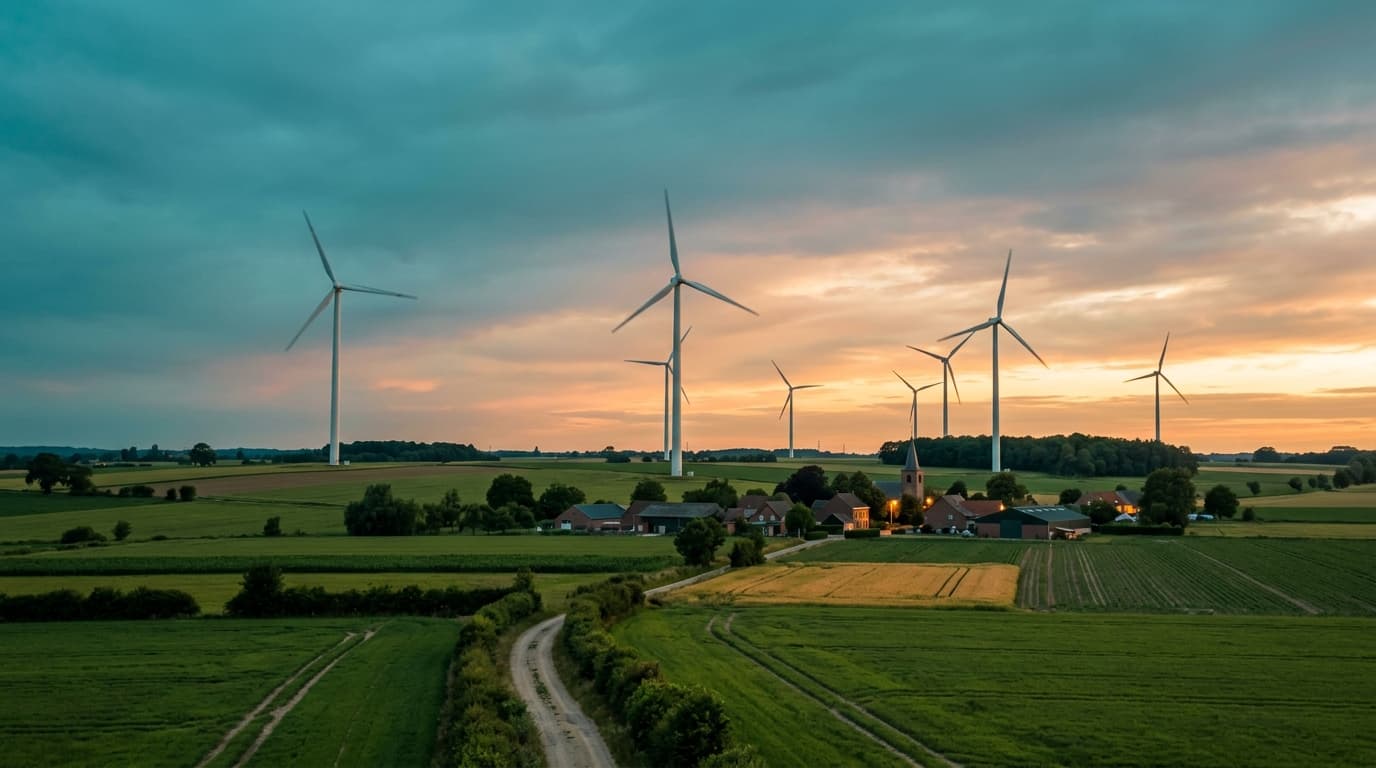
Buying your electricity from a citizen cooperative means becoming a co-owner of the wind turbines that produce it. In Belgium, two names dominate this quiet corner of the market: Ecopower in Flanders, Cociter in Wallonia. The model comes with its own rules — a share to buy, limited regional coverage — and deserves a calm comparison. For the whole market, see our ranking of the best electricity suppliers.
What is a cooperative electricity supplier?
It is a supplier owned by its own customers, who are also its shareholders. In practice, instead of a listed group returning profits to investors, you have a cooperative company where every member holds a share and one vote at the general assembly, regardless of how many shares they own. Profits first fund new installations — wind turbines, solar panels, small hydro plants — and then, possibly, a rebate to members. The difference with a conventional supplier is therefore not cosmetic: it changes who decides, who collects and where the money from your bill goes. In Belgium, the REScoop Wallonie federation alone brings together around twenty citizen cooperatives and more than 23,000 members.
Which is the best cooperative electricity supplier in Belgium?
Ecopower in Flanders and Cociter in Wallonia: these are the only two genuine cooperatives that supply households directly. Both score 20/20 in the Greenpeace ranking of Belgian suppliers published in late 2025 — a score shared only by the local cooperative Wase Wind. Around them orbit suppliers "backed by citizens" without the full status, such as Aspiravi Energy, sourced from partner cooperatives. Here is how they compare in July 2026.
| Supplier | Status | Region supplied | Share to buy | Price reference (3,500 kWh/year)* | Best for |
|---|---|---|---|---|---|
| Ecopower | Approved cooperative (since 1991) | Flanders | €250, mandatory | ~€1,252/year | Maximum green, in Flanders |
| Cociter | Grouping of 12 citizen cooperatives | Wallonia | Share in a member cooperative (amount varies) | ~10.71 c€/kWh peak, 9.62 c€/kWh off-peak + €53 standing charge | Locally owned Walloon wind power |
| Aspiravi Energy | Supplier backed by partner cooperatives | Flanders | None | Variable, indexed monthly to Belpex | Local green without joining a cooperative |
| EnergyVision | Belgian green supplier (not a cooperative) | Belgium | None | Variable | Belgian green with simple sign-up |
| Bolt | Independent Belgian green supplier | Belgium | None | Variable / dynamic | Credible green anywhere in Belgium |
| Mega | Commercial supplier (price benchmark) | Belgium | None | ~€1,027/year | The cheapest point of comparison |
*Estimates for July 2026, household using 3,500 kWh/year, single meter, excluding promotions. Sources: supplier rate cards, CallMePower readings and the Greenpeace ranking.
Do you have to buy shares to become a cooperative customer?
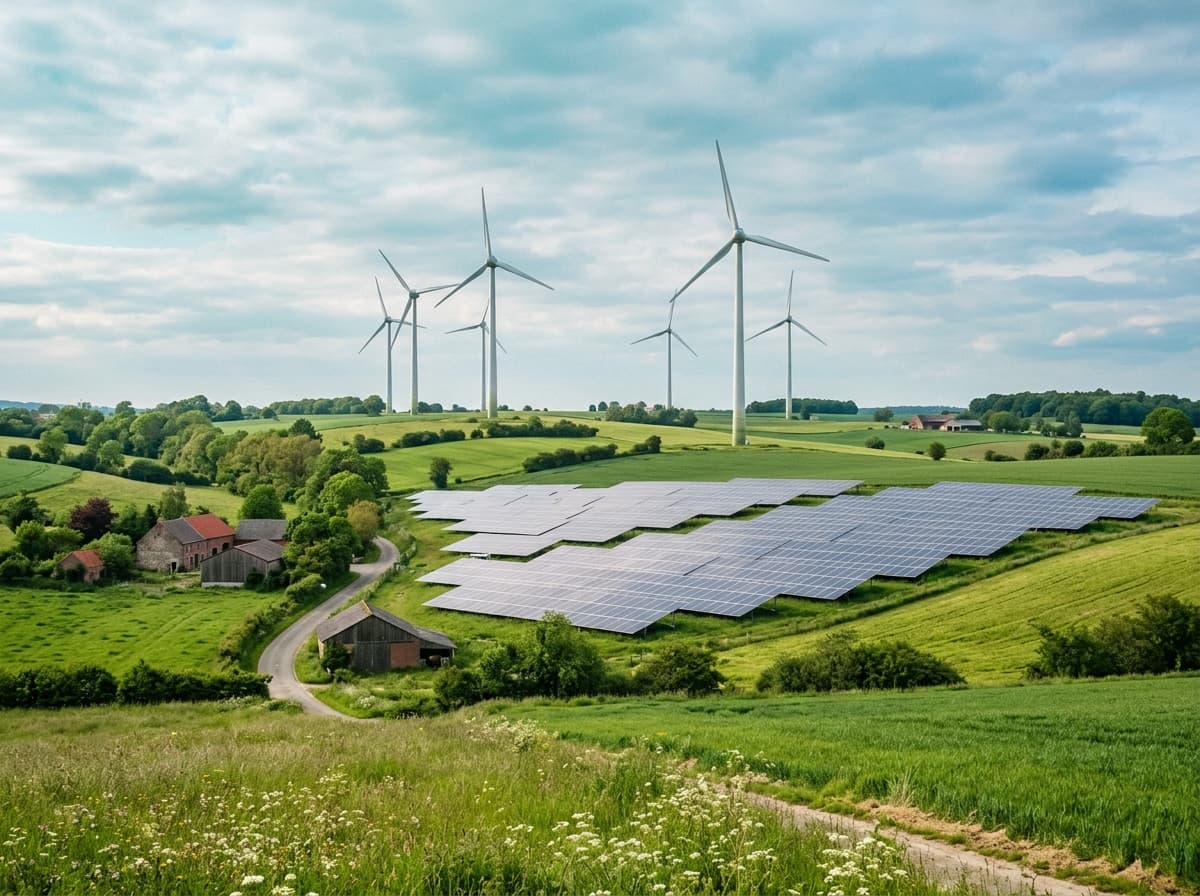
At Ecopower, yes — and it is the main surprise for newcomers. You must be a member before being a customer, which means buying at least one share at €250. At Cociter, the mechanism is indirect: you join one of the twelve member citizen cooperatives, the one covering your region, where the share price varies from one structure to another. Always check that amount with your local cooperative before committing. Aspiravi Energy asks for nothing: it buys its electricity from partner cooperatives without requiring you to join. That entry barrier explains, in my view, why so many households who admire the cooperative model never make the move: €250 to pay upfront is a real psychological hurdle, even when the money remains your property.
Is cooperative electricity more expensive?
More expensive than the discounter, cheaper than the incumbents. This is the figure most articles forget to give. As of 1 July 2026, an annual bill for 3,500 kWh comes to around €1,252 at Ecopower, against roughly €1,027 for the cheapest offer on the Walloon market (Mega Cosy Flex, €0.1593/kWh) — but €1,288 at Engie and €1,294 at Luminus. In other words, the cooperative costs you about €225 more per year than the cheapest option, but saves you some forty euros compared with the two large incumbent suppliers. On the Walloon side, Cociter posts very sober energy prices (around 10.71 c€/kWh at peak hours and 9.62 c€/kWh off-peak, plus a €53 annual standing charge), to which network costs and taxes are added as everywhere. A useful reminder: the CREG puts the energy component between €0.106 and €0.171/kWh in mid-2026, and the all-in price sits around €0.30/kWh including VAT. The supplier component therefore never accounts for more than about a third of your bill.
Which cooperative is available in your region?
Regional coverage is the real constraint of the cooperative model, far more than price. Ecopower supplies the Flemish Region, full stop. Cociter supplies Wallonia and brings together certified local cooperatives, mainly wind-based. In Brussels, cooperative offers for households are virtually non-existent: it is the hole in the map. If you live in Brussels and care about Belgian green power, the choice shifts to an independent supplier such as Bolt or EnergyVision, or to the green offer of a conventional supplier — knowing that you then lose the citizen-ownership dimension. Each regional regulator also publishes its own official comparator (VREG in Flanders, CWaPE in Wallonia, Brugel in Brussels), and that is always where a price should be validated before signing.
Cooperative or conventional green supplier: which should you choose?
Choose the cooperative if you want to fund Belgian generation, an independent green supplier if you want simplicity. The difference rests on a technical but decisive point: Ecopower and Cociter physically produce in Belgium the electricity they sell, whereas a large share of the market's so-called green offers rely on guarantees of origin bought abroad — a legal mechanism, but one that creates no additional wind turbine here. That is exactly what the Greenpeace ranking penalises, where cooperatives take the top places while several big names remain at the back of the pack. In practice, I recommend the cooperative to settled households, owners or long-term residents, who can tie up a share. For a tenant who moves often or a tight budget, a Belgian green supplier with no shares already does much of the job. Our dedicated guide to the best green electricity supplier details how to sort credible green from greenwashing.
How do you switch to a cooperative supplier without nasty surprises?
Three checks are enough, in this order. First, availability: confirm that the cooperative supplies your postcode — it is the number one reason applications are refused. Then, the share: ask for its exact amount, the refund conditions if you leave, and the rebate policy of recent years; a cooperative share remains an investment whose capital is not guaranteed, unlike a savings account. Finally, the real price: have your exact annual consumption simulated, not a theoretical package, and compare it with two commercial offers. The switch itself carries no risk: in Belgium it is free, with no notice charge and no interruption, your network operator (Fluvius, ORES, RESA or Sibelga) staying the same. Allow around three weeks of administrative processing. Before signing, review all the offers in our ranking of electricity suppliers.
In short, the cooperative supplier is not the cheapest choice in Belgium, but it is the only one that turns your bill into Belgian wind turbines you partly own. If you live in Flanders or Wallonia and €250 tied up does not scare you, it is the most coherent investment a household committed to green power can make. Compare before you sign — as always.
Électricité verte comparator
Compare all électricité verte side by side.
Compare now →
Frequently asked questions
Julien suit le marché belge de l'énergie depuis plus de dix ans. Il a comparé des centaines d'offres d'électricité pour des ménages wallons, bruxellois et flamands, décortiqué les grilles tarifaires de Mega, Bolt, Luminus, Engie ou Eneco, et épluché les rapports de la CREG, du VREG et de la CWaPE. Sa conviction : la plupart des Belges paient leur électricité trop cher faute d'avoir comparé. Sur ce site, il traduit le jargon énergétique en conseils concrets, chiffrés et sans publicité déguisée.