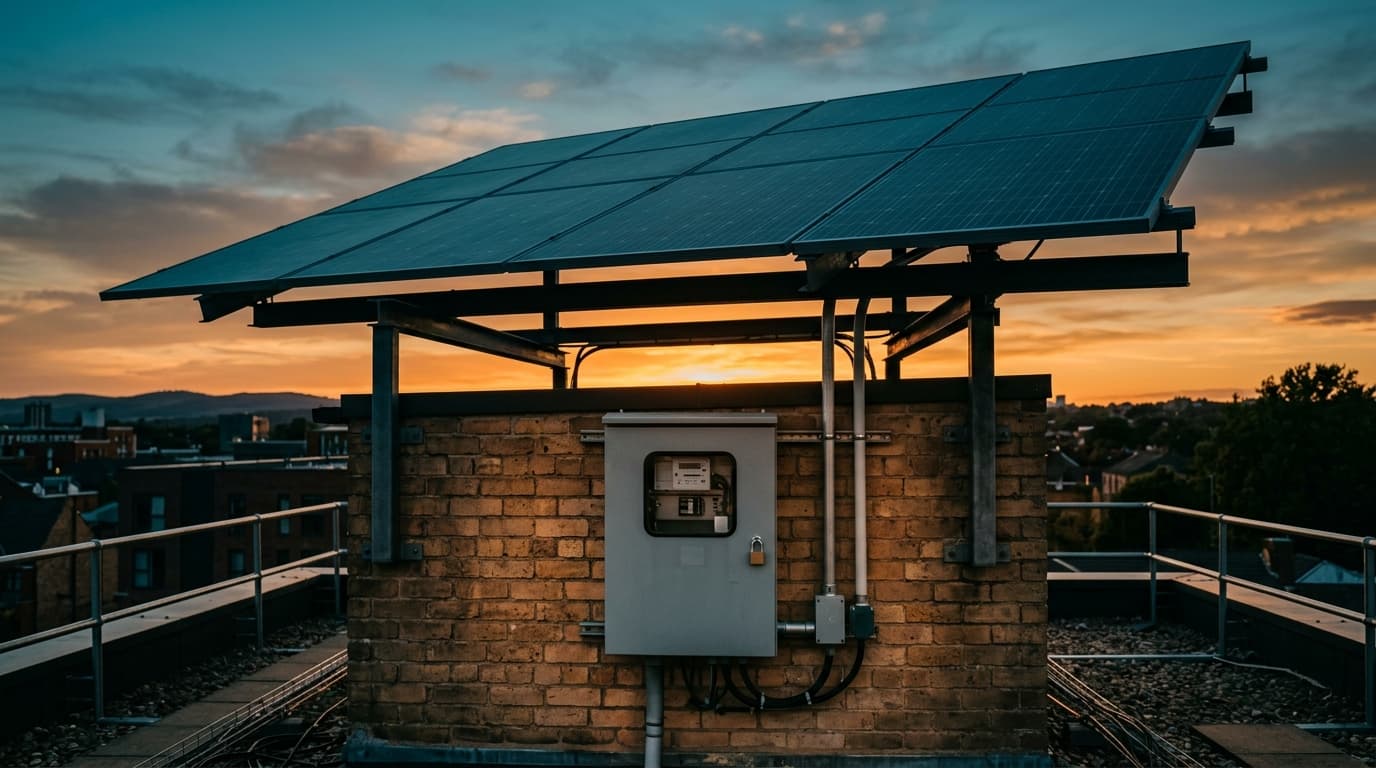
The prosumer tariff is a network charge, not a tax, and only prosumers still under net metering pay it. In Wallonia it costs between 81.04 and 99.29 euros per kWe per year depending on the network operator. In Brussels it has never existed.
Is the prosumer tariff a tax?
No.
CWaPE, the Walloon energy regulator, opens its dedicated page with one sentence: it is not a tax. The prosumer tariff is a charge for using the distribution network. Your supplier bills it, then passes it on to your distribution network operator, the GRD. No levy, no tax authority.
Prosumer tax is nevertheless what half of Belgian searchers type on the subject. The intuition is understandable: a line that appeared on a bill in 2020, with no visible counterpart, looks a lot like a levy. The real logic is different. A prosumer whose meter runs backwards draws from the grid at night and pushes power back at midday, without those movements being measured separately. The charge covers that invisible usage.
Who still pays the prosumer tariff in Belgium?
Far fewer people than you would think. Four conditions have to be met at once:
- Being connected to the low-voltage network in Wallonia or Flanders, never in Brussels.
- Producing your own electricity with a decentralised installation of 10 kVA or less, photovoltaic in almost every case.
- Still benefiting from net metering, in other words from the backwards-running meter principle.
- Not being on the social tariff, an all-inclusive price that already covers network costs.
The third condition rules out most recent installers. In Wallonia, installations certified from 1 January 2024 leave the net metering regime and therefore pay no prosumer tariff at all: they are billed on their real withdrawals, and their injection is bought back by their supplier.
| Region | Prosumer tariff | Calculation base | Who still pays |
|---|---|---|---|
| Wallonia | Yes, since 1 October 2020 | Net developable capacity (kWe) | Installations certified before 2024, no smart meter |
| Flanders | Yes, since 1 July 2015 | Maximum AC inverter output (kVA) | The minority still on an analogue meter |
| Brussels | Never introduced | Not applicable | Nobody, net metering ended November 2021 |
Flanders deserves a note. By the end of 2025, according to Test-Achats, the Belgian consumer association, 90 % of those subject to the prosumer tariff already had a digital meter and had therefore left the regime. The remaining cases are mostly households whose connection needs preparatory works, or who have a night-only meter for storage heating.

How much does the prosumer tariff cost per network operator?
Here is the figure nobody publishes clearly. The tariff is expressed in euros per kWe per year, and each GRD applies its own, approved by CWaPE. A Walloon prosumer with a 5 kWe inverter pays 405.20 euros a year in the AIEG area, 429.20 euros with ORES and 496.45 euros with AIESH, a gap of 91.25 euros between two households that bought exactly the same installation, a few dozen kilometres apart.
| Network operator | €/kWe per year | On 3 kWe | On 4 kWe | On 5 kWe |
|---|---|---|---|---|
| AIEG | 81.04 € | 243.12 € | 324.16 € | 405.20 € |
| RESA | 84.22 € | 252.66 € | 336.88 € | 421.10 € |
| ORES | 85.84 € | 257.52 € | 343.36 € | 429.20 € |
| REW | 93.00 € | 279.00 € | 372.00 € | 465.00 € |
| AIESH | 99.29 € | 297.87 € | 397.16 € | 496.45 € |
Amounts include 6 % VAT for tariff year 2026, recorded on 18 September 2026 in the Test-Achats dossier updated on 29 January 2026. CWaPE publishes its own tables excluding VAT, which explains why figures differ from one site to the next: always check whether a quoted amount is gross or taxed.
Set against an electricity bill, the weight becomes clear. Our market readings from August 2026 put the annual bill of a 3,500 kWh household between 1,304 and 1,589 euros. The 343.36 euros paid by an ORES prosumer with 4 kWe therefore represent 22 to 26 % of that total, for a line many people discover only when their annual adjustment bill lands.
On the Flemish side the mechanics differ: the tariff applies to the maximum AC output of the inverter and is calculated monthly according to the distribution of sunshine hours. The 2026 amounts range from 54.63 euros per kVA at Fluvius Antwerpen to 69.59 euros at Fluvius West, or 218.52 to 278.36 euros a year on 4 kVA.
Five steps to check the amount billed
Allow twenty minutes, your latest adjustment bill, the conformity certificate for your installation and your EAN code. Cost of the check: zero euros.
- Confirm your regime. Find the certification date of your installation. Before 1 January 2024 in Wallonia, you are under net metering and therefore liable. After that date, you are not.
- Locate the line. The prosumer tariff appears on the annual adjustment bill, inside the network costs block, under its exact name and rarely in a prominent position.
- Check the capacity used. The GRD bills the net developable capacity, the lower of the peak panel rating and the inverter output. An error here is corrected with the GRD, not with the supplier.
- Estimate your real self-consumption. A household out all day sits around 30 %. A heat pump, an electric car charged at midday or a controlled water heater easily push that rate above 50 %.
- Decide. Above 40 % self-consumption, ask for billing on your gross withdrawals. Below it, the flat-rate capacity charge remains your better option.
Should you switch to gross metering to pay less?
Two figures circulate, and only one is the real threshold. CWaPE built the capacity tariff on a self-consumption assumption of 37.76 %, repeated everywhere as though it were the tipping point. The genuine threshold sits elsewhere: the regulator's tariff guarantee states that a prosumer with a dual-flow meter will never pay more than the capacity amount, including where their self-consumption turns out to be below 40.26 %.
In other words, gross metering becomes genuinely advantageous above 40.26 %, and it can never cost you more.
The worked example published by CWaPE shows it well. A 5 kWe installation, 7,000 kWh consumed, 50 % self-consumption, in the ORES area: network costs come to 728.47 euros under the capacity regime against 643.43 euros on gross withdrawals. Annual saving: 85.04 euros. The cheaper calculation is applied automatically, with no action from you.
| Your situation | Applicable regime | Useful action |
|---|---|---|
| Walloon installation certified before 2024, self-consumption under 40 % | Flat-rate capacity charge | Raise self-consumption before changing meter |
| Walloon installation certified before 2024, self-consumption above 40 % | Gross withdrawals, capped | Request the smart meter, free of charge |
| Walloon installation certified from 2024 onwards | Real withdrawals plus injection rate | Compare suppliers' injection rates |
| Flemish prosumer with a digital meter | Gross withdrawals, no net metering | Check the injection buy-back on the bill |
| Brussels prosumer | Real withdrawals | Nothing to do |
Can you still refuse a smart meter in Wallonia?
Not since 9 January 2026. ORES states that the new provisions of the Walloon electricity decree, in force from that date, generalise the smart meter and make its installation compulsory. Refusal, long possible in Wallonia, no longer exists. The operator is targeting full deployment by the end of 2029, and installation remains free, accessories included, even when you request it early.
That piece of information is missing from every page still dominating search on the subject, comparator dossiers and installer factsheets alike. Yet it changes the question: the debate is no longer whether you want gross metering, but when it will arrive.
Six mistakes come up again and again among Walloon prosumers:
- Confusing kWp and kVA. The tariff applies to the lower of the two ratings, not to the one your installer advertised. Our article on the difference between kW and kWh explains these units.
- Believing a smart meter ends net metering. In Wallonia it does not: the deduction of injected kilowatt-hours still applies on the bill.
- Fearing a higher bill under gross metering. The CWaPE guarantee rules that out.
- Paying while on the social tariff. Federal and regional protected customers are exempt.
- Applying Flemish figures in Wallonia. The calculation bases and the amounts have nothing in common.
- Waiting for a grant that no longer exists. The regional reimbursement ended after tariff year 2023.
What happens to Walloon net metering after 2030?
It stops. ORES confirms that the mechanism runs until 31 December 2030 for installations certified before 1 January 2024. On 1 January 2031, those prosumers move into the regime of recent installations: withdrawal and injection counted separately, network costs on the kilowatt-hours genuinely drawn from the grid, and injection sold back to your supplier.
The injection rate then becomes the variable that matters, and it varies widely from one contract to the next. Mega and Eneco each publish an explanatory page on the subject, on the prosumer tariff and on the prosumer rate respectively, while Engie, Luminus and TotalEnergies fold it into their specific terms. None publishes a grid comparable across suppliers, which makes a manual comparison unavoidable.
One freshness note, finally, for anyone hunting the official amount. On 18 September 2026, the prosumer tariff page of RESA still showed a table stopping at 2023, and pointed to the full 2020 and 2021 reimbursement as though it were current. Your network operator's own website is not always the most up to date source on its own tariffs.
Beyond that, VREG, the Flemish regulator, publishes the Flemish tariffs, Brugel covers the Brussels rules, and the official Walloon procedure page sets out the decree framework. If you already generate your own electricity, our guide to the best supplier for solar panels compares injection rates, our ranking of the best electricity suppliers gives the full annual cost and the bill simulator adjusts it to your consumption. Any work on the fuse box or the connection is a job for a certified electrician, and the installation must stay compliant with the statutory inspection.
Électricité verte comparator
Compare all électricité verte side by side.
Compare now →
Frequently asked questions
Julien suit le marché belge de l'énergie depuis plus de dix ans. Il a comparé des centaines d'offres d'électricité pour des ménages wallons, bruxellois et flamands, décortiqué les grilles tarifaires de Mega, Bolt, Luminus, Engie ou Eneco, et épluché les rapports de la CREG, du VREG et de la CWaPE. Sa conviction : la plupart des Belges paient leur électricité trop cher faute d'avoir comparé. Sur ce site, il traduit le jargon énergétique en conseils concrets, chiffrés et sans publicité déguisée.