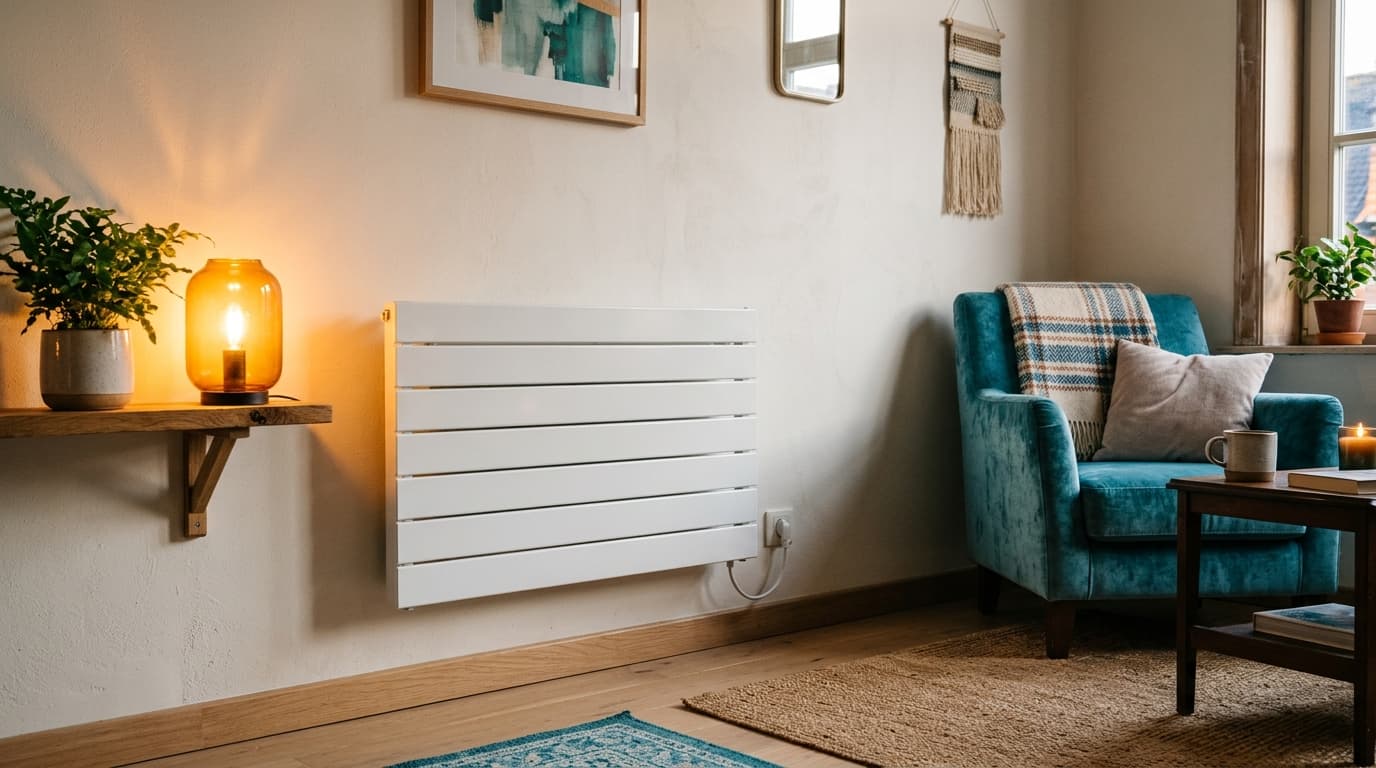
An inertia electric radiator (radiateur à inertie) uses no less electricity than a new convector: both turn every kWh into one kWh of heat. It only saves money against an old, poorly controlled convector, and even then a recent convector or an air to air heat pump often pays for itself faster.
A kWh is a kWh, whatever the radiator
Let us start with physics, because advertising forgets it. An electric resistance turns all the electricity it receives into heat, with no loss: convector, radiant panel, fluid or dry inertia radiator, all share the same production efficiency, the maximum. Test-Achats, the Belgian consumer association, says so bluntly in its file "No miracle electric heating": the only differences lie in emission and control losses, around 5 to 10 % for a standard unit and up to 20 % in unfavourable cases.
The word itself guarantees nothing. In a news piece dated 15 August 2026, Selectra points out that "inertia" is protected by no certification: it is sales vocabulary, which the French performance standard for electric radiators does not even mention.
The real difference of an inertia radiator lies in its mass. A core of cast iron, ceramic, soapstone or heat transfer fluid stores heat and releases it after the resistance switches off, which smooths the room temperature instead of letting it swing. Comfort changes. A 1,500 W fluid model and a 1,500 W convector nevertheless draw exactly the same power while their resistance is heating. The amount of electricity needed to keep a given room at 19 °C depends on insulation and settings, not on the material hidden behind the front panel.
How much does an hour of electric radiator cost in Belgium?
Multiply power by the price per kWh. A 2,000 W unit running one hour at full power uses 2 kWh; the concept is explained in our article on the difference between kW and kWh. For the price, I use the reference rate calculated by the CREG (the federal energy regulator) for Q4 2026, published by Securex on 4 September 2026: 37.79 c€/kWh in Wallonia, 36.88 c€ in Brussels and 32.25 c€ in Flanders, all in.
| Power | 1 hour, Wallonia | 1 hour, Brussels | 1 hour, Flanders | 4 h a day for 30 days, Wallonia |
|---|---|---|---|---|
| 500 W | €0.19 | €0.18 | €0.16 | €22.67 |
| 1,000 W | €0.38 | €0.37 | €0.32 | €45.35 |
| 1,500 W | €0.57 | €0.55 | €0.48 | €68.02 |
| 2,000 W | €0.76 | €0.74 | €0.65 | €90.70 |
These amounts are ceilings.
The thermostat cuts the resistance as soon as the set temperature is reached, so a 1,500 W radiator does not draw 1.5 kWh every hour in a room that is already warm. The CREG rate is also an average that includes fixed charges: the extra kWh you actually pay for is slightly cheaper.
Take a 1,500 W plug in heater switched on four hours every evening for 150 days, with a thermostat that runs it 60 % of the time. That gives 540 kWh, or €204 in Wallonia and €174 in Flanders for a single room. That is the order of magnitude to keep in mind before talking about savings.
Why do manufacturers still promise savings?
Because they compare their new product with a twenty year old convector. Manufacturer and renovation websites mention up to 15 % savings against an "old convector", often without a source. Thermor, a subsidiary of the Atlantic group, writes that its inertia radiators use less "thanks to their many features": programming, presence detection, open window detection. Everything is in that sentence, since those features belong to temperature control, not to inertia.
And control has become mandatory for every unit. Since 1 January 2018, EU Regulation 2015/1188 has set a minimum seasonal efficiency of 38 % for a fixed electric local space heater, 36 % for a portable unit and 38.5 % for a storage heater, a threshold that a fixed unit only reaches in practice with an electronic thermostat and a timer. A new convector sold in Belgium therefore carries most of what makes up the claimed advantage of an inertia radiator.
What remains is an indirect gain, real but modest. More stable heat can lead you to lower the setting by one degree without discomfort, and each degree less cuts heating consumption by about 7 % according to ADEME, the French energy agency, a figure quoted by Selectra. When I read product sheets, I therefore look for the controls first, before the material. Here are the criteria that matter, in this order:
- Power matched to the room: 60 to 100 W per m² depending on insulation, according to the ranges published by Selectra and Quelle Énergie; an undersized unit runs non stop, an oversized one costs more to buy.
- Electronic thermostat and weekly programming, which let you lower the temperature at night and during absences.
- Open window detection, plus presence detection for rooms used intermittently.
- Declared mass and material on the technical sheet: a light, flat "inertia radiator" with no stated material is probably a renamed convector.
- Room by room control, through a pilot wire or a connected module, if you heat several rooms with electricity.
Dry or fluid inertia? Consumption is identical at equal settings. Fluid heats up a little faster, cast iron or ceramic keep the heat a little longer: a matter of comfort.
Replacing an old convector pays back in 4 to 35 years
I redid the calculation for a 30 m² living room with average insulation heated by an old convector with a mechanical thermostat. Based on the ratio published by Selectra (about 4,800 kWh a year for 100 m²), this room uses about 1,500 kWh a year, or €567 in Wallonia and €484 in Flanders at the CREG rate for Q4 2026.
Assumptions: a well controlled new unit recovers 5 to 10 % of control losses, the Test-Achats range; the inertia radiator adds, in the optimistic scenario, one degree less on the setting, i.e. 7 %; the air to air heat pump is calculated with a SCOP (seasonal coefficient of performance) of 3.5, cautious compared with the 5.10 certified by Eurovent for the Daikin Perfera FTXM25R in an average climate. Prices read at Thermor (update of 10 February 2026, about €100 of fitting per radiator) and at Test-Achats (13 January 2026, single split air to air heat pump installed).
| Replacing the old convector | Installed price | kWh saved per year | Annual gain, Wallonia | Payback, Wallonia | Payback, Flanders |
|---|---|---|---|---|---|
| New convector with electronic thermostat | €208 to €256 | 75 to 150 | €28 to €57 | 3.7 to 9.0 years | 4.3 to 10.6 years |
| Fluid inertia radiator | €400 to €1,000 | 75 to 255 | €28 to €96 | 4.2 to 35.3 years | 4.9 to 41.3 years |
| Single split air to air heat pump | €1,500 to €3,000 | about 1,070 | €405 | 3.7 to 7.4 years | 4.3 to 8.7 years |
Three readings. The new €108 convector almost matches a €900 inertia radiator, because both mostly buy the same thing: a modern thermostat. The inertia radiator's range is huge, from four years for an entry level model in the best scenario to more than thirty five years for a high end model that only brings the control gain, which is longer than the lifespan of about sixteen years that Quelle Énergie quotes for dry inertia. Finally the air to air heat pump, several times more expensive to buy, pays back fastest, because it is the only one that produces more heat than the electricity it consumes.
Brussels lands within a few tenths of Wallonia. Flanders, with a cheaper kWh, stretches every payback by about 17 %.
Wallonia, Brussels, Flanders: the same radiator does not cost the same
In Flanders, the bill does not depend on kWh alone. Since 2023, the network share there has been calculated on each month's quarter hour power peak, at €51.99 to €60.53 per kW per year including VAT depending on the Fluvius zone in 2026. A 2,000 W radiator that starts at the same time as the oven or the hob can raise that peak by 2 kW, or €104 to €121 more a year if it happens every month. Programming preheating outside meal times therefore has a financial benefit specific to Flanders, detailed in our article on the Flemish capacity tariff.
Wallonia offers another lever. Since 1 January 2026, dual rate off peak hours have covered 11 am to 5 pm and 10 pm to 7 am every day according to ORES, the main Walloon DSO (distribution system operator, the grid operator you cannot choose), which makes it possible to preheat a room in the early afternoon. The mass of an inertia radiator prolongs that heat a little, nothing like a storage heater designed to charge at night and release heat during the day.
In Brussels, off peak hours remain nights and weekends at Sibelga. And everywhere, the off peak gain only exists if your supplier really sells the night kWh for less. In the CallMePower survey of 26 October 2026 quoted in our article on the dual rate meter, OCTA+ Boost Flex charged 18.72 c€ by day and 13.29 c€ at night, while EnergyVision applied 10.60 c€ to both periods.
On grants, Test-Achats stated in January 2026 that air to air heat pumps remained excluded from grants in Wallonia and Brussels, but eligible in Flanders under conditions. No regional grant for a direct electric radiator appears in the sources consulted.

Which mistakes cancel out the benefit of an inertia radiator?
Most of them come down to use, not to the product. Here are those that come up most often in the questions I receive:
- Heating a whole house with 2,000 W plug in heaters instead of tackling insulation or considering a heat pump.
- Never programming the unit, which brings a €900 radiator down to the level of a €108 convector left on continuously.
- Buying on the word "inertia" alone without checking mass, material and controls on the technical sheet.
- Replacing an exclusive night circuit and its storage heaters with inertia radiators that will consume during peak hours.
- Adding powerful units to an old installation without advice from a certified electrician: beyond the socket, the cable cross section and circuit protection are at stake, and any change must remain compliant with the RGIE (the Belgian general regulation on electrical installations) and its inspection.
The inertia radiator pays off in comfort, rarely in euros
It has its place, but a narrow one. It makes sense in a room used for long hours and heated by electricity with no other option, when the old convector has to be replaced anyway, and when gentler heat matters to you.
| Your situation | The most rational choice |
|---|---|
| Old convector without electronic thermostat, room rarely used | New programmable convector |
| Living room heated by electricity every day, limited budget | Entry level inertia radiator, properly programmed |
| Living room or main room, budget of €1,500 or more | Air to air heat pump, through a certified installer |
| Existing exclusive night circuit | Keep or upgrade the storage heaters |
| Home in Flanders with several radiators | Schedule start ups outside cooking peaks |
One last variable weighs more than the choice between cast iron and fluid: the price per kWh you pay. With 1,500 kWh of heating per room, every cent of difference is worth €15 a year per room. Our article on the best supplier for electric heating details suitable offers, and the ranking of the best electricity suppliers shows where yours stands; the simulator then works out your own profile.
Réduire sa facture comparator
Compare all réduire sa facture side by side.
Compare now →
Frequently asked questions
Julien suit le marché belge de l'énergie depuis plus de dix ans. Il a comparé des centaines d'offres d'électricité pour des ménages wallons, bruxellois et flamands, décortiqué les grilles tarifaires de Mega, Bolt, Luminus, Engie ou Eneco, et épluché les rapports de la CREG, du VREG et de la CWaPE. Sa conviction : la plupart des Belges paient leur électricité trop cher faute d'avoir comparé. Sur ce site, il traduit le jargon énergétique en conseils concrets, chiffrés et sans publicité déguisée.