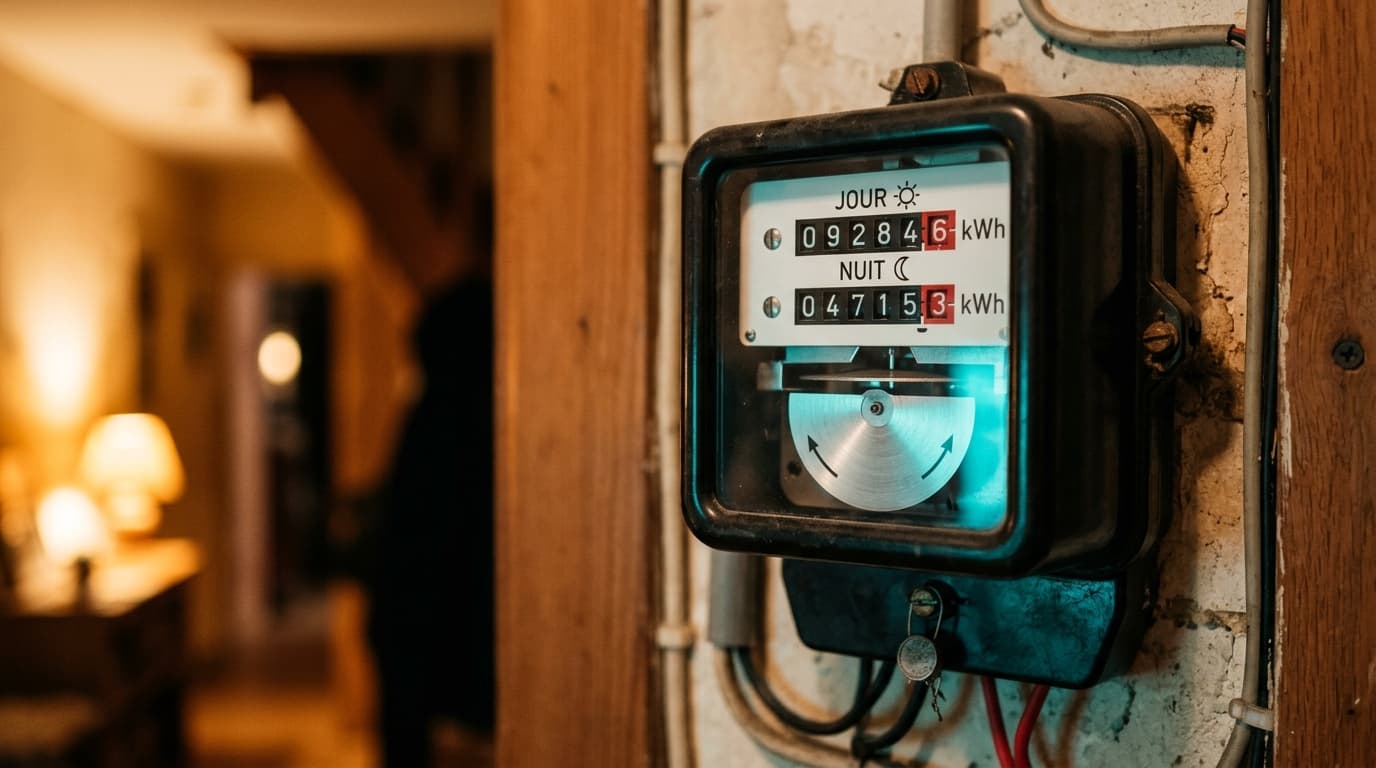
A dual rate meter (compteur bihoraire) records your consumption on two separate registers, one for peak hours and one for off peak hours, which are billed at a lower price. It only pays off if a large enough share of your kWh falls in the right window: about 22 % in Wallonia, much more elsewhere, and sometimes never in Flanders.
How does a dual rate meter work?
It counts twice. During peak hours, a first register moves forward; during off peak hours, the grid operator switches counting to a second one. Your bill then applies two prices per kWh, one per register.
On a digital meter, those two registers carry a code. 1.8.1 shows daytime consumption, 1.8.2 night time consumption; if you feed solar power back to the grid, two further registers under 2.8 count what you send out. Scroll through the display with the meter's button until you reach these codes, and note both values on the day you move house or submit your annual reading. Report only one of the two, and the supplier estimates the other.
A single rate meter has one register and one price. The exclusive night meter is a separate circuit that powers a single appliance, often a water heater or storage heaters.
What are the dual rate hours in each region?
They depend on your DSO (distribution system operator, the grid operator you cannot choose), not on your supplier. Wallonia changed its schedule on 1 January 2026; Brussels and Flanders kept the old pattern of nights and weekends.
| Region | Off peak hours | Weekend | Public holidays |
|---|---|---|---|
| Wallonia (ORES, RESA) | 11 am to 5 pm and 10 pm to 7 am | Same schedule as weekdays | Normal schedule |
| Brussels (Sibelga) | 10 pm to 7 am on weekdays | Friday 10 pm to Monday 7 am | Off peak |
| Flanders (Fluvius) | 10 pm to 7 am, 9 pm to 6 am in a few municipalities | Friday 10 pm to Monday 7 am | Not stated by the sources |
Wallonia went from 93 to 105 off peak hours a week according to ORES, the main Walloon DSO, which means 15 hours every day. The price paid for this is subtle: Saturday and Sunday are no longer entirely off peak. A Walloon household that used to run every wash on Sunday afternoon stays off peak until 5 pm, then pays the full rate from 5 pm to 10 pm, precisely the slot when many families cook, wash and charge their car.
The 9 pm to 6 am offset applies to a handful of Flemish municipalities, and Fluvius publishes the list. Check yours before programming anything.

How much does a dual rate meter cost?
It all depends on the meter already installed in your home. With a digital meter, the switch is done by software and you request it from your supplier, who forwards it to the grid operator. With an old electromechanical single rate meter, the device has to be replaced.
| Region | Digital meter | Older meter | Source |
|---|---|---|---|
| Wallonia (ORES) | Remote switch, no fee published | €250 to €400 estimated | ORES, CallMePower (26/12/2025) |
| Brussels (Sibelga) | No fee published | About €360 estimated | CallMePower (26/12/2025) |
| Flanders (Fluvius) | €10.70 one off administration fee | Not published | CallMePower NL (22/07/2026) |
The "older meter" amounts are comparison site estimates, not official prices. Ask the grid operator for a quote before committing: at €360, it takes several years of savings to pay the operation back, as the next section shows. The EAN code (the 18 digit identifier of your supply point) does not change with the device; our article on the EAN code of your meter explains why.
From what night share does the dual rate pay off?
The thresholds going around range from one to double. ORES mentions about 25 %, other guides 28 %, Selectra 50 %, and our own guide to off peak electricity suppliers used 40 %. None of the guides consulted shows the calculation. I redid it from the network tariff grid, because that is where most of the gap sits in Wallonia.
The 2026 ORES grid published by the CWaPE, the Walloon energy regulator, sets distribution at 9.21 c€/kWh excluding VAT on a single rate, 10.43 c€ in peak hours and 4.88 c€ in off peak hours. Peak hours therefore cost more than the single rate, and that is the whole trap. The break even point lands at 21.95 % of consumption in off peak hours. With the VAT inclusive amounts read by CallMePower on 22/10/2026 (11.98, 13.27 and 7.39 c€/kWh), you get 21.9 % again. Here is what the network share alone gives for a household using 3,500 kWh a year.
| Off peak share | Network on single rate | Network on dual rate | Annual difference |
|---|---|---|---|
| 20 % | €419.30 | €423.29 | Loss of €3.99 |
| 30 % | €419.30 | €402.71 | Gain of €16.59 |
| 40 % | €419.30 | €382.13 | Gain of €37.17 |
| 50 % | €419.30 | €361.55 | Gain of €57.75 |
| 60 % | €419.30 | €340.97 | Gain of €78.33 |
On top of this network gain comes, or not, the supplier's. And that is where the comparison gets revealing.
In CallMePower's survey of dual rate offers for October 2026, updated on 26/10/2026, three of the four cheapest contracts charge the night kWh at the same price as the day one: EnergyVision at 10.60 c€, Ecofix at 16.94 c€ and Eneco Soleil et Vent Flex One at 16.71 c€. Only OCTA+ Boost Flex differentiates, at 18.72 c€ by day and 13.29 c€ at night, a 5.43 c€ gap. For a Walloon household shifting 700 kWh from day to night, that means €41 saved on the network side and €38 more on the energy side at OCTA+, against zero at the other three. In Brussels, the network gap is only 2.29 c€ per kWh according to Infor GazElec (5.72 against 3.43 c€), or €16 for the same 700 kWh. In Flanders, it is zero.
The Flemish network tariff has no longer distinguished day from night since 1 January 2023: the network share there depends on your peak power, detailed in our article on the capacity tariff in Flanders. A Flemish dual rate meter is therefore only worth having if your supplier actually sells night power for less.
Should you keep a dual rate meter with solar panels?
Yes, in most recent setups. The new Walloon 11 am to 5 pm window matches solar production: the kWh you still draw from the grid around midday are billed at the off peak rate. ORES also states that the dual rate changes neither self consumption nor the prosumer tariff.
The exception concerns older Walloon installations under net metering, whose meter still runs backwards. When production exceeds consumption over the year, the interplay of the two registers can turn against you, and CallMePower then advises a single rate.
Brussels is preparing the end of the dual rate
On 8 July 2026, Brugel, the Brussels energy regulator, adopted its decision 390 on advanced tariffs. Two stages: a capacity tariff in 1 kVA steps on 1 January 2028, then three time periods on 1 January 2030, identical every day (peak from 5 pm to 10 pm, day from 7 am to 5 pm, night from 10 pm to 7 am). The regulator considers it likely that the classic dual rate will disappear by then and favours switching dual rate meters to single rate. Guidelines are expected in June 2027.
None of the top three guides in the search results mentions it. For a Brussels household, that puts paying today for the replacement of an older meter into perspective.

How do you switch from dual rate to single rate, or the other way round?
Through your supplier, never directly with the grid operator: the supplier forwards the request to ORES, Sibelga or Fluvius. Before filing it, check these five points.
- Your real night share: read both registers at the start and end of a typical week, then divide night consumption by the total. Tracking your consumption in real time gives the same answer without effort.
- The price gap in your offer: if your contract bills night at the day price, switching only earns the network share.
- Your region: a network gain exists in Wallonia and Brussels, not in Flanders.
- The type of meter: on a digital one, the operation is nearly free; on an electromechanical one, it runs into hundreds of euros.
- The programmed schedule: in Wallonia, ORES asks you to report it if the meter has not switched to the new windows since January.
Once you know your profile, compare the offers that genuinely separate day and night in our ranking of the best electricity suppliers, then work out your own case with the bill simulator.
Tarifs & prix comparator
Compare all tarifs & prix side by side.
Compare now →
Frequently asked questions
Julien suit le marché belge de l'énergie depuis plus de dix ans. Il a comparé des centaines d'offres d'électricité pour des ménages wallons, bruxellois et flamands, décortiqué les grilles tarifaires de Mega, Bolt, Luminus, Engie ou Eneco, et épluché les rapports de la CREG, du VREG et de la CWaPE. Sa conviction : la plupart des Belges paient leur électricité trop cher faute d'avoir comparé. Sur ce site, il traduit le jargon énergétique en conseils concrets, chiffrés et sans publicité déguisée.